
Mandatory Strata Committee Training in NSW from 1 October 2026

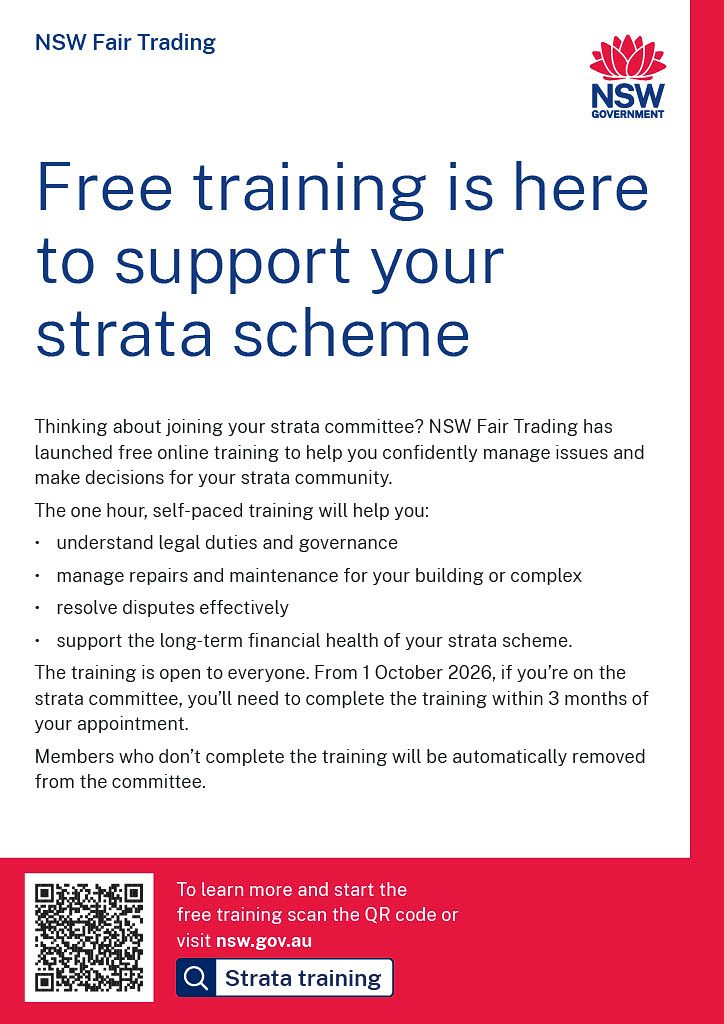
A practical guide for Sydney strataCommittees and owners corporations
The short answer
From 1 October 2026, new and returning NSW strata committee members must complete free online training delivered by NSW Fair Trading within three months of being appointed. The requirement is annual. For people appointed between 1 October 2026 and 30 September 2027, the required course is Introduction to Strata Committee Rights and Responsibilities. It is self paced, takes about one hour and will be accessed through Strata Hub.
The consequence matters. If a committee member does not complete the required training by the deadline, that person automatically stops being a committee member. The vacancy occurs even if the secretary has not sent a notice. This makes training a governance deadline, not simply optional professional development.
There are exemptions for committee members in two lot strata schemes, strata managing agents, members of the Australian College of Strata Lawyers and people filling a casual vacancy for less than three months. The requirement applies to strata committees in strata schemes, but not association committees in community land schemes.
NSW Fair Trading has published a dedicated strata committee training guide. Every committee, secretary and strata manager should use that page as the primary source and check it again on or after 1 October, when the access steps and course link are expected to be added.
Why this reform matters
Strata committee members make practical decisions about other people's homes, money and shared property. A committee may consider waterproofing, fire safety, insurance, by law enforcement, contractor quotations, legal advice, levy budgets and a ten year capital works fund plan within the same year. In a large scheme, those decisions can involve substantial contracts and affect hundreds of residents. In a small walk up, the committee may have fewer resources but still carry the same need for sound process.
The new training requirement is intended to establish a shared base of knowledge for both first time and experienced members. NSW Fair Trading says the training will help members understand their legal duties and governance role, navigate repairs and disputes, manage risk and support the financial health of their scheme. The broader guide to the 2026 strata law changes also connects the course with informed decisions about budgets, repairs and long term planning.
Training will not turn a volunteer committee member into a lawyer, engineer or accountant. It should, however, make it easier to recognise when the committee can decide a matter, when an owners corporation resolution is required, what should be recorded and when specialist advice is sensible. That shared foundation can improve meetings and reduce avoidable misunderstandings between committee members, owners and the strata manager.
The commencement date and the appointment trigger
The new rule starts on 1 October 2026. The key trigger is a person's appointment to the strata committee on or after that date, not simply the arrival of 1 October.
A person appointed on 1 October 2026 has until 1 January 2027 to complete the required training. A person appointed on 1 June 2027 has until 1 September 2027. These examples come directly from NSW Fair Trading and show why the scheme should calculate an individual deadline from each appointment date.
A current committee member who was appointed before 1 October 2026 does not suddenly have a three month deadline on commencement day. They will need to train when they are next appointed, although they may voluntarily complete the course earlier. For many schemes, the next appointment will occur at the annual general meeting when the new committee is elected.
This distinction is important for Sydney schemes whose AGM falls late in the calendar year. A committee elected at a November 2026 AGM will be caught immediately and each non exempt member will have a February 2027 deadline. A committee elected in September 2026 will generally wait until its next appointment, but its members can still take the course voluntarily when it launches.
Who must complete the training
The requirement applies to new and returning strata committee members appointed from 1 October 2026. Long service does not remove the obligation. A chairperson, secretary or treasurer who has served for many years is still a returning committee member when appointed again.
It also applies to a person appointed to fill a vacancy lasting more than three months. This prevents a substantial midyear appointment from falling outside the training system. The official guidance distinguishes that situation from a short casual vacancy of less than three months, which is exempt.
The practical rule is to assess every appointment individually. After an AGM or general meeting, record the member's full name, appointment date, calculated training deadline and any claimed exemption. Do not assume that the strata manager's involvement means owner members are covered by the manager's professional status. A strata managing agent may be exempt personally, but owner representatives on the committee must meet their own obligations.
The course is also open voluntarily to owners, residents and potential nominees. A person considering nomination can use it to understand the commitment before joining. Existing members appointed before commencement and members of two lot schemes can also participate without being legally required to do so.
What the first course involves
For appointments between 1 October 2026 and 30 September 2027, the required course is called Introduction to Strata Committee Rights and Responsibilities. NSW Fair Trading describes it as free, online, self paced and approximately one hour long. It will be available through Strata Hub.
The official training page says access instructions will be added when the course launches. Committees should avoid circulating unofficial paid courses as though they satisfy the statutory requirement. A useful workshop from an industry provider may improve knowledge, but the mandatory course is the training delivered by NSW Fair Trading for this purpose.
The requirement is annual. NSW Fair Trading says that after the introductory training, committee members will have access to further training each year and that details of the 2027 requirements will be published later. Committees should therefore build an annual process rather than treating the October 2026 launch as a one off exercise.
The three month deadline in practice
The safest approach is to create the deadline as soon as a person is appointed. Do not use a vague reminder such as three months after the AGM. Record the actual calendar date and check whether the official course has been completed early enough to resolve any access problem.
NSW Fair Trading recommends that the secretary send a reminder no later than two months after appointment. That leaves roughly one month for the member to complete the course and provide the Certificate of Completion. Fair Trading plans to publish a reminder template closer to launch.
A workable sequence is:
1. Record the appointment date in the meeting minutes and the committee training register.
2. Give every new or returning member the official training link and their personal due date promptly.
3. Ask exempt members to provide evidence of the exemption to the secretary.
4. Send a written reminder no later than two months after appointment.
5. Ask trained members to provide their Certificate of Completion within the three month period.
6. Check the register before every committee meeting held near or after a member's deadline.
7. If no certificate has been provided by the deadline, address the membership and vacancy immediately.
Finishing early is sensible. Login trouble, an outdated email address or a last minute misunderstanding about the due date should not place committee membership at risk.
Exemptions that committees should record
The official guidance identifies four exemptions. Committee members in two lot strata schemes do not have to complete the mandatory training. That exemption aligns with the separate October 2026 reforms for most duplex style schemes, explained in our two lot strata changes guide. They may still take the course voluntarily.
Strata managing agents are exempt. Members of the Australian College of Strata Lawyers are also exempt. A person filling a casual vacancy for less than three months is exempt for that short appointment.
An exemption should not live only in someone's memory. NSW Fair Trading says an exempt member should provide evidence to the committee secretary. The secretary can keep the evidence with the committee's training records and note the basis of the exemption. If the facts change, reassess the position. For example, a vacancy initially expected to be short may need closer attention if the appointment continues.
The requirement applies to strata committees in strata schemes. It does not apply to association committees in community land schemes. Mixed developments can have multiple governance layers, so identify which body the person has joined before deciding whether the strata committee training rule applies.
What happens if a member misses the deadline
If training is not completed within three months of appointment, the person automatically stops being a strata committee member. A notice from the secretary is not what creates the vacancy. The loss of membership occurs because the deadline was missed.
NSW Fair Trading encourages the secretary to issue a Failure to Complete Training Notice as soon as practicable if no Certificate of Completion has been provided by the deadline. The notice should tell the person that they are no longer on the committee. Fair Trading expects to publish a template closer to 1 October 2026. The secretary should also notify the remaining committee members promptly.
Once the committee knows about the failure, it should prevent the former member from taking part in future committee decisions and consider whether the vacancy must be filled. According to the official guidance, appointing a new committee member to fill the vacancy requires a general meeting of the owners corporation. A large scheme with more than 100 lots must maintain at least three committee members, so a missed deadline could create an immediate operational issue.
If the person is appointed again during the same 12 month period in which they were first appointed, they receive a fresh three month period from the new appointment date to complete the training. Reappointment is not a reason to leave records unclear. Minute the new appointment and calculate the new deadline.
Are earlier committee decisions invalid
Not automatically. NSW Fair Trading says a committee decision involving someone who failed to train on time will generally remain valid if the committee acted in good faith because it did not know that the person had ceased to be a member.
That protection should not be treated as permission to ignore the training register. It is directed to good faith lack of knowledge. After the committee becomes aware of the failure, it should stop the former member participating and deal with the vacancy. A disputed decision may depend on its facts, timing and the relevant legislation, so obtain legal advice for a material or contested issue.
The best risk control is simple administration: calculate due dates, send reminders, collect certificates and verify current membership before decisions. That is much easier than reconstructing who was eligible to vote after a dispute arises.
The practical role of the secretary
NSW Fair Trading places particular emphasis on the secretary's administrative role. It recommends collecting Certificates of Completion, keeping copies for at least one year, sending reminder notices no later than two months after appointment, issuing failure notices where necessary and promptly informing the remaining committee about a vacancy.
The certificate is issued by NSW Fair Trading when a member completes the course. Members should give a copy to the secretary within the training period. A central electronic folder is preferable to certificates sitting in individual inboxes. The file name can include the member, completion date and training year without exposing the document more widely than necessary.
Fair Trading's specific recommendation is to keep certificates and reminder notices for at least one year. Schemes should also consider their broader statutory record keeping duties and their established records policy. The NSW Government's record keeping requirements explain that required scheme records created from 11 June 2024 must be kept electronically and that communications and meeting records generally have longer retention requirements.
If a strata manager performs secretarial functions under delegated authority, the committee and manager should agree who will send reminders, receive certificates, update the register and escalate a missed deadline. Clear responsibility avoids the dangerous assumption that someone else is monitoring compliance.
A simple training register
A spreadsheet or secure scheme register can make the process visible without becoming burdensome. Include the committee member's name, role, appointment date, whether training is required, the reason for any exemption, the three month due date, reminder date, completion date, certificate received date and status.
Restrict access to people who need it and keep the source documents in the owners corporation's record system. Use the register as an administrative aid, not as a replacement for certificates, meeting minutes or formal notices.
The register should be reviewed after each AGM, after any general meeting that fills a vacancy, when an office bearer changes and before meetings close to a deadline. Add a recurring calendar reminder for the secretary or strata manager at the two month point and several working days before the final deadline.
Preparing before the October commencement
Committees do not need to wait for the course link to organise their governance. Before 1 October 2026, an owners corporation can:
identify the expected date of its next AGM and likely appointment dates
update committee member contact details and confirm Strata Hub information
tell likely nominees about the new requirement before nominations close
create the training register and secure certificate folder
nominate the person responsible for reminders and follow up
add training compliance to the handover checklist for a new secretary or strata manager
bookmark the official training page and check it when the course launches
discuss how a vacancy would be managed if a member misses the deadline
NSW Fair Trading says it will email committee members whose contact details are recorded on Strata Hub as part of strata reporting. Accurate details improve the chance that members receive updates, but each scheme should still operate its own process. Government emails are a useful prompt, not the committee's complete compliance system.
How the reform changes AGMs and nominations
The training requirement should be explained before or during the nomination process in plain language. Potential members need to know that appointment carries a free one hour course and a firm three month deadline. That transparency is more likely to produce willing, informed nominees than a surprise notice after the AGM.
The election itself must still follow the meeting rules. Use the NSW Government's guide to running strata meetings and seek advice if nominations or committee size are disputed. The meeting minutes should clearly identify who was appointed and the date, because that date starts the clock.
After the meeting, send one concise onboarding message containing the official training link, deadline, certificate instructions, committee contacts and relevant governance documents. Returning members should receive the same compliance message as first time members. A familiar face is still subject to the annual requirement when reappointed.
Committees may also encourage nominees to complete the course voluntarily before the AGM once it becomes available. Voluntary early learning can improve confidence, but the scheme should verify how the official annual requirement applies following appointment rather than assuming an earlier course always satisfies a later obligation.
Working with the strata manager
A capable strata manager can support the process by maintaining the register, diarising deadlines, distributing official material and storing records when those functions are within the management agreement or delegated authority. The committee remains responsible for understanding its membership and should not become passive.
Agree the workflow in writing. Decide who receives certificates, who checks the official source for updates, who sends reminders, how a missed deadline is escalated and who drafts the general meeting material if a vacancy must be filled. Include training status in the committee handover when management changes.
Training also gives committees a stronger basis for working with professional advice. Members who understand governance, finances and maintenance can frame better questions and distinguish a committee decision from a matter reserved for the owners corporation. For ongoing support, see ETSM strata management services or contact our team.
Sydney examples
In an older six lot Coogee walk up, the AGM is held on 12 November 2026 and three owners are appointed to the committee. Each non exempt member should record a deadline three months from that appointment. Their training is directly relevant when the building later considers salt affected balcony repairs, waterproofing and contractor scopes. Our guide to maintaining common property in NSW can support that discussion, but it does not replace the official course.
In Randwick, Maroubra or Bondi Junction, committees may balance ageing services, concrete or membrane repairs, fire safety work and rising insurance costs. A one hour common foundation will not solve those projects, but it can improve how members read agendas, ask for evidence and record decisions. A practical NSW strata AGM checklist can help the scheme connect appointment records with its post AGM training workflow.
In Marrickville, Newtown, Enmore, Dulwich Hill or Petersham, a boutique scheme may have strong owner participation but frequent committee turnover. The register matters because a member appointed midyear to a vacancy may have a different deadline from colleagues elected at the AGM. A converted warehouse or mixed residential building may also face renovation, acoustic and access questions that reward clearer governance.
In Leichhardt or Balmain, a small committee may rely heavily on one experienced secretary. The new law is a reason to document the process so compliance does not depend on one person's memory. Shared calendar entries, a secure folder and a short handover note create resilience when office bearers change.
In North Sydney, Neutral Bay, Cremorne, Cammeray, Crows Nest, Wollstonecraft or Waverton, larger apartment buildings can have more members, more contracts and faster committee turnover. A deadline dashboard is especially useful where multiple appointments, casual vacancies and office bearer changes occur. Committees dealing with major works should also connect their training with a current ten year capital works fund plan.
These suburbs are governed by the same NSW training law. The hyperlocal difference lies in the building stock, committee size, repair profile and meeting calendar. The compliance rule stays consistent while the practical reason for better decisions changes from building to building.
Common mistakes to avoid
The first mistake is assuming only new committee members must train. Returning members appointed on or after commencement are also covered. The second is using 1 October as everyone's personal deadline. It is the commencement date; the three month period runs from appointment.
Another mistake is treating any strata seminar as the mandatory course. Use the NSW Fair Trading course accessed through Strata Hub. External learning may be valuable, but it should not be represented as satisfying the requirement unless the official guidance says so.
Do not rely entirely on a reminder email from government or the strata manager. The member has an obligation, and the scheme needs an auditable process. Do not wait for a failure notice to assume a vacancy exists, because membership ends automatically when the deadline is missed.
Finally, do not discard certificates after a quick visual check. Keep the certificate and reminder record for at least the period Fair Trading recommends, and align the process with the scheme's broader electronic record keeping obligations.
A practical checklist for every appointment
When a committee member is appointed on or after 1 October 2026:
1. Confirm whether the person is appointed to a strata committee covered by the rule.
2. Check whether one of the four published exemptions applies.
3. Record the appointment date in the minutes and training register.
4. Calculate the exact three month deadline.
5. Send the official course link and certificate instructions.
6. Record evidence if the member claims an exemption.
7. Send a reminder no later than two months after appointment.
8. Collect and securely store the Certificate of Completion.
9. Confirm status before meetings after the due date.
10. If training is incomplete, stop future participation and address the vacancy promptly.
This is a short process, but it protects the integrity of committee decisions and gives volunteers a clearer start in the role.
Frequently asked questions
1 When does mandatory NSW strata committee training start
It starts on 1 October 2026. New and returning committee members appointed on or after that date must complete the required NSW Fair Trading training within three months of appointment unless an exemption applies.
2 Do current committee members have to train on 1 October
Not simply because the date arrives. A member appointed before 1 October 2026 does not need to train until next appointed, although they can take the course voluntarily once available.
3 How long does the course take and what does it cost
NSW Fair Trading says the introductory course is free, online, self paced and takes about one hour. It will be available through Strata Hub from commencement.
4 Do returning committee members have to complete it
Yes. The requirement applies to both new and returning committee members appointed from 1 October 2026. Previous committee experience is not a general exemption.
5 Are two lot strata schemes exempt
Yes. Committee members in two lot strata schemes are exempt from mandatory training, although they can complete it voluntarily. Other October 2026 changes also remove annual Strata Hub reporting for two lot schemes.
6 What happens if a member misses the three month deadline
They automatically stop being a committee member. This occurs even if the secretary has not issued a notice. The committee should prevent further participation and check whether a general meeting is needed to fill the vacancy.
7 Does a strata manager complete the course for the committee
No. A strata managing agent may be personally exempt, but each owner member must satisfy their own training requirement or exemption. The manager can support reminders and records if authorised to do so.
8 How long should the secretary keep certificates
NSW Fair Trading encourages secretaries to keep Certificates of Completion and reminder notices for at least one year. The scheme should also comply with wider statutory record keeping requirements that may apply to related communications and meeting records.
9 Does the rule apply to community land association committees
No. The published guidance says the training applies to strata committees in strata schemes and not to association committees in community land schemes. Mixed developments should identify the relevant body carefully.
The next step for Sydney committees
The best preparation is administrative rather than complicated. Record appointment dates, assign responsibility, calculate individual deadlines, use the official course, collect certificates and act promptly if someone misses the deadline.
For Sydney owners corporations, the new rule is also an opportunity to improve committee induction. Give every member the same core information, connect training with the AGM handover and keep the evidence where the next secretary can find it. That approach supports more consistent decisions in Eastern Suburbs walk ups, Inner West conversions and Lower North Shore towers alike.
For help setting up a practical committee governance workflow or improving the broader management of your scheme, contact Ellouise Tyrrell Strata Management.
Important information
This article provides general information current at 16 September 2026. It is not legal advice and does not account for every scheme, appointment or dispute. Check the NSW Government strata committee training page, the NSW strata law changes page and the legislation in force when applying the rules. Obtain legal advice for a contested appointment, decision or vacancy.
Official and practical resources
NSW Fair Trading strata committee training
NSW guide to strata law changes for committees and owners
NSW serving on a strata committee hub
NSW strata record keeping requirements