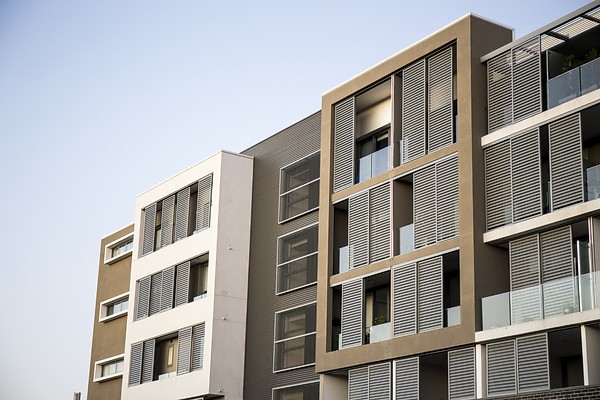
Water Leaks and Waterproofing in Batemans Bay Strata Buildings Who Is Responsible
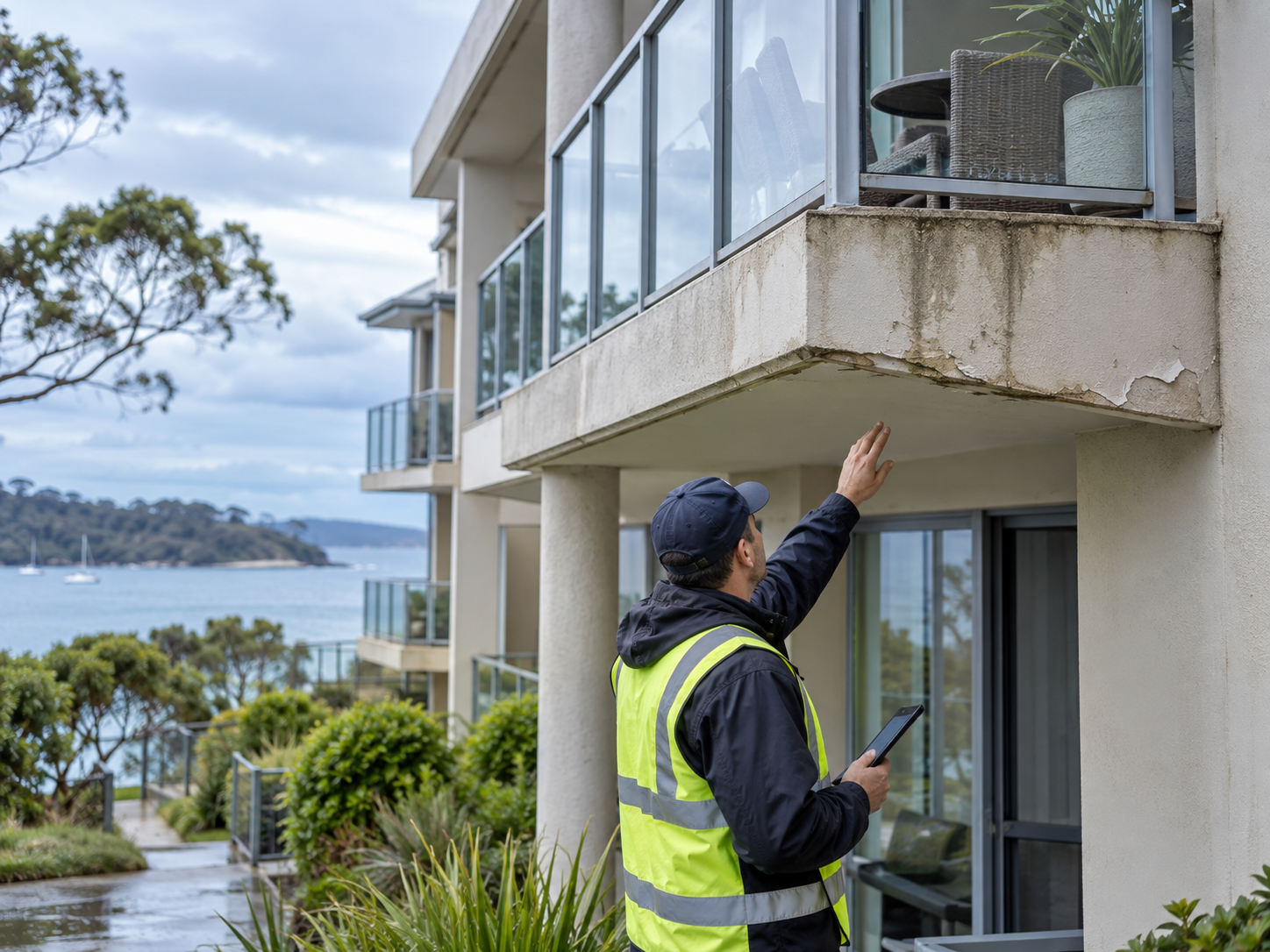
A Practical Guide for Batemans Bay Batehaven Catalina Surfside and Eurobodalla Owners Corporations. A Practical Guide for Batemans Bay Batehaven Catalina Surfside and Eurobodalla Owners Corporations
Water entering an apartment building can begin as a small stain on a ceiling or a damp patch beside a window and quickly become a much larger strata issue.
For owners corporations in Batemans Bay and surrounding coastal communities, water ingress deserves particular attention. Roofs, balconies, windows, external walls, drainage systems and waterproofing membranes all form part of the building envelope, and a failure in one area can cause damage somewhere completely different.
The source is not always obvious. Water appearing inside a ground-floor apartment may have originated from a balcony several levels above. Moisture beside a window may be caused by failed sealant, defective flashing or water entering through the facade rather than the window itself. A ceiling stain might come from roofing, plumbing, stormwater infrastructure or an upstairs wet area.
This is why determining responsibility for a water leak in strata should usually begin with finding the cause rather than making assumptions about which owner should pay.
For strata committees across Batemans Bay, Batehaven, Catalina, Surfside, Long Beach, Sunshine Bay, Denhams Beach and the wider Eurobodalla region, early investigation can help prevent relatively manageable maintenance problems from becoming expensive remedial projects.
NSW Government guidance confirms that an owners corporation is generally responsible for maintaining and repairing common property, while individual owners are responsible for items within their lot. Roofs, gutters, boundary walls, balconies, balcony doors, windows and water damage originating from common property are examples commonly identified as owners corporation responsibilities. See NSW Government guidance on strata repairs and maintenance. However, every building should be considered individually. The registered strata plan, existing by-laws, renovation history and exact cause of the water ingress can all affect responsibility.
1.Why Water Ingress Matters in Batemans Bay Strata Buildings
Waterproofing problems occur in strata buildings throughout NSW, but the South Coast presents its own maintenance environment.
Batemans Bay buildings range from older walk-up apartment blocks and small villa complexes to larger residential developments, holiday apartments and mixed-use schemes. Many properties are also located close to the coast, waterways, sloping land or heavily vegetated areas.
The important issue is not simply whether a building is close to the beach. Owners corporations need to consider how the complete property manages water. Roof drainage, gutters, downpipes, balconies, paved areas, retaining walls, garden beds, stormwater lines and surface drainage all need to work together.
Eurobodalla Shire Council provides local guidance about stormwater and private property. It notes that buildings need adequate stormwater drainage connected to an appropriate legal point of discharge and explains how excavation, retaining walls or other development can alter existing overland water flows.
2.Who Is Responsible for Water Leaks in NSW Strata
The starting point is the distinction between common property and lot property.
Under section 106 of the Strata Schemes Management Act 2015 NSW, an owners corporation has a duty to properly maintain and keep common property in a state of good and serviceable repair. It must also renew or replace fixtures and fittings forming part of common property when required.
That does not mean every water leak automatically becomes an owners corporation expense. The cause needs to be established.
An owner will generally be responsible for items located within their lot, including internal fixtures and certain plumbing fixtures, as well as water damage caused by something within their own property.
There can be exceptions. A bathroom, balcony or other area may have been renovated and responsibility may subsequently be governed by a renovation by-law or common property rights by-law. The scheme may also have adopted a common property memorandum.
For this reason, responsibility should normally be determined by reviewing the physical cause of the problem alongside the strata plan and relevant by-laws.
The duty to maintain common property is set out in section 106 of the Strata Schemes Management Act 2015.
3.Finding the Source Should Come Before Allocating Blame
A common mistake in water-damage disputes is deciding responsibility based on where the water appears. That can be misleading.
Water can travel horizontally along slabs, framing, cavities and services before becoming visible. A wet ceiling underneath an apartment does not automatically establish that the owner above is responsible. Likewise, water beside an external door does not necessarily mean the door itself has failed.
The appropriate first step is usually to establish where the moisture is entering the building, which building component has failed, whether that component forms part of common property or lot property, whether renovations have altered responsibility and what repair is required to prevent the problem recurring.
For straightforward problems, a licensed plumber or appropriately qualified contractor may be able to identify the cause. For more complicated water ingress involving balconies, facades, roofing, structural movement or repeated waterproofing failures, an owners corporation may need advice from a suitably qualified building consultant, engineer or waterproofing specialist.
Spending money identifying the actual source can be considerably more effective than repeatedly repairing damaged paint, plaster or flooring without fixing the underlying defect.
4.Roof Leaks in Batemans Bay Apartment Buildings
Roofs are one of the most important areas for an owners corporation to maintain. NSW Government strata guidance lists roofs and gutters among the common examples of owners corporation responsibility.
A roof leak can result from deteriorated flashing, failed roof penetrations, damaged tiles or sheeting, blocked gutters, corroded components, failed seals around vents or insufficient drainage.
A leak may only become noticeable during certain weather conditions. Water entering during wind-driven rain may follow a different path from water entering during prolonged rainfall. Intermittent leaks can therefore require careful inspection rather than simply attending the building on a dry day.
For Batemans Bay schemes, roof and gutter maintenance should form part of a broader preventative maintenance program. Owners corporations should not wait until water is entering an apartment before considering the condition of roof drainage.
Periodic inspection of accessible roof areas, gutters, downpipes, penetrations and visible flashing can help identify deterioration earlier.
5.Balcony Waterproofing and Water Leaks
Balconies are one of the more complicated sources of water ingress in strata buildings. The visible tiled surface is only one part of a balcony system.
Underneath or around that surface may be a waterproofing membrane, screed, drainage outlet, flashing, door threshold, slab, balustrade penetrations and junctions with external walls. If one component fails, water may travel into the apartment below, adjacent walls or the building structure.
NSW Building Commission information identifies balcony waterproofing as an area capable of constituting a serious waterproofing defect. It also explains that waterproofing in an individual apartment, including a balcony, may be common property where there has been no later renovation affecting responsibility.
That distinction is important. If an owner has previously renovated a balcony or wet area, the relevant approvals and by-laws should be checked before deciding who is responsible for later repairs.
A balcony leak should therefore be investigated properly before anyone simply regrouts the tiles or applies sealant. Surface treatments can sometimes temporarily reduce water entry while leaving the underlying waterproofing problem unresolved.
Further information about serious waterproofing defects is available from Building Commission NSW.
6.Bathroom and Laundry Waterproofing
Bathrooms, laundries and other wet areas are another common source of water damage between apartments.
A stain appearing on the ceiling below a bathroom can potentially result from plumbing, a failed waterproofing membrane, a leaking shower screen, damaged grout, drainage connections or another building component. Again, responsibility depends on the source.
NSW Government guidance says owners are generally responsible for internal fixtures such as baths, toilets, sinks and showers, while plumbing located in boundary walls and under floors is generally an owners corporation responsibility.
Renovations introduce another important issue. NSW strata renovation guidance confirms that bathroom renovations generally require approval and that owners should check their scheme's by-laws before starting work.
Where a previous owner has renovated a bathroom or laundry, the strata committee should examine the approval records and any relevant by-law when a waterproofing problem later develops.
Maintaining accurate strata records becomes particularly important in these situations. Several years after a renovation, the current committee may otherwise have little knowledge of what work was approved or what responsibilities were transferred to the lot owner.
Owners and committees can review the NSW Government strata renovation rules before work begins.
7.Windows Sliding Doors and Wind Driven Rain
Water around windows and balcony doors can be particularly difficult to diagnose.
NSW Government guidance generally identifies windows, window locks, balconies and balcony doors among typical owners corporation responsibilities. However, discovering moisture next to a window does not automatically prove that the window itself is defective.
Water could be entering through deteriorated external sealant, flashing, masonry cracks, facade joints, balcony thresholds or another location higher on the building. Wind-driven rain can further complicate the investigation.
The correct repair may therefore involve the building facade rather than simply replacing an internal seal. For older coastal apartment buildings around Batemans Bay, periodic inspection of exterior joints and building-envelope components can help identify deterioration before significant internal damage occurs.
8.External Walls and Facade Water Ingress
External walls form an important part of the protection between an apartment and the weather.
Cracking, deteriorated sealants, failed joints or defects around windows and service penetrations can allow moisture to enter the building. This type of leak can sometimes appear only after sustained or wind-driven rain.
Because water may travel within wall cavities, the visible internal damage may be some distance from the actual entry point. Repeated internal patching is unlikely to solve this type of problem.
Where facade water ingress is suspected, an owners corporation may need specialist investigation that looks at the exterior building envelope rather than simply the damaged internal area.
The Building Defects Library contains technical information about waterproofing, building enclosures and moisture-management defects.
9.Basement and Garage Water Problems
Basement garages and lower-ground common areas can present another set of challenges. Water may enter because of surface runoff, blocked drainage, deteriorated waterproofing, groundwater, plumbing failures or stormwater infrastructure.
The problem can become more noticeable during periods of heavy rain. For properties on sloping sites, surface water needs to be managed carefully so it is not directed toward the building.
For a strata committee, recurring basement water should prompt investigation beyond simply pumping the area dry after every storm. The source, drainage capacity and pathway of the water need to be understood.
10.Stormwater Is Different From Waterproofing
Stormwater and waterproofing problems can produce similar symptoms but often require different solutions.
Waterproofing generally prevents moisture penetrating through building components. Stormwater infrastructure controls rainwater moving across or away from the property.
A waterproof membrane cannot compensate for an inadequate stormwater system, and improving drainage will not necessarily repair a failed balcony membrane.
This distinction can become particularly important in larger or sloping strata schemes around Eurobodalla. A problem might involve roof water, surface runoff, a blocked pit, inadequate falls, retaining wall drainage or water being redirected toward the building.
Understanding which system is failing can help the owners corporation engage the right professional and avoid unnecessary work.
11.Do Not Keep Repairing the Damage Without Repairing the Cause
Water stains are often the symptom rather than the defect.
Painting a ceiling, replacing damaged plaster or cleaning mould may restore the appearance of an apartment, but none of those actions will prevent further damage if water is still entering.
A good repair process separates the source repair from the consequential damage. First, stop the water. Then allow affected materials to dry appropriately. After that, determine what reinstatement work is required.
This sounds straightforward, but strata schemes can lose considerable time when cosmetic repairs are undertaken before the source of the leak has been conclusively identified. The result may be the same ceiling being repaired multiple times.
12.Why Early Action Matters
Small water leaks rarely become cheaper by being ignored.
Moisture can damage plasterboard, timber, flooring, cabinetry, electrical components and finishes. Persistent moisture may also contribute to mould growth and deterioration of building materials.
There is also the potential for disputes between owners when a problem continues without a clear repair plan.
A committee that responds quickly, obtains appropriate professional advice and keeps affected owners informed is generally in a stronger position than one that allows uncertainty to continue for months.
The NSW strata building repairs health check explains the financial and insurance risks associated with delayed maintenance.
13.What Should a Strata Committee Do When a Leak Is Reported
The first objective should be to establish whether immediate action is needed to prevent further damage.
Photographs can be useful, particularly where water ingress only occurs during particular weather conditions. The committee or strata manager should gather information about when the leak occurs, where it appears and whether similar problems have previously been reported.
Relevant strata records should also be checked. Previous building reports, waterproofing work, roof repairs, renovation approvals, insurance claims and meeting minutes can sometimes reveal that the problem has occurred before.
The appropriate contractor or consultant can then be engaged to investigate. Once the source has been identified, the owners corporation can determine responsibility, obtain the required quotations and approve an appropriate repair.
14.Emergency Water Leaks
Not every leak can wait for the next strata committee meeting.
A burst common-property pipe, serious roof failure or significant water ingress during a storm may require immediate action to reduce further damage.
Every strata scheme should have a practical process for reporting urgent building problems. Owners and residents should know who to contact outside ordinary office hours and what information should be provided.
Fast communication can substantially reduce damage. The circumstances should be documented and evidence such as photographs, invoices and written information from the attending contractor should be retained.
15.When Should a Building Consultant or Engineer Be Engaged
Not every dripping tap requires an engineer. However, repeated or complex water ingress can benefit from independent professional investigation.
This can be particularly useful where several possible sources exist, previous repairs have failed, substantial waterproofing works are proposed or the issue affects multiple lots.
A professional report can assist a committee by defining the defect, identifying likely causes and recommending an appropriate scope of remedial work. That scope can then be used to obtain comparable quotations.
Without a clear scope, contractors may propose entirely different approaches, making it difficult for the committee to compare price or understand whether each quotation actually addresses the same problem.
For significant remedial building works, there may also be regulatory requirements relating to designs and registered practitioners. Professional advice should be obtained where those requirements may apply.
NSW Government guidance explains requirements that can apply to remedial building work.
16.Waterproofing Work Should Be Done Properly
Waterproofing should not be treated as a cosmetic trade.
NSW Government licensing information describes waterproofing as trade work and outlines licensing requirements for residential waterproofing work above the applicable monetary threshold.
For an owners corporation considering major balcony, roof or wet-area remediation, contractor selection should therefore consider more than price.
The committee should look at licensing, insurance, experience, the proposed scope of works, warranties and whether appropriate design documentation is required. A very cheap waterproofing quotation can become expensive if the repair needs to be repeated.
Contractors and owners corporations can check the NSW Government requirements for waterproofing work licences.
17.Water Leaks and Strata Insurance
Insurance and maintenance are related, but they are not the same thing.
An insurance policy may respond to certain resulting damage from an insured event, but insurance should not be regarded as a substitute for maintaining the building.
When water damage occurs, the owners corporation should determine both what maintenance or building repair is needed and whether any resulting damage should be referred to the insurer or insurance broker.
Policy wording and individual circumstances vary, so committees should obtain advice regarding specific claims rather than assume that every waterproofing failure will be insured.
18.Newer Apartment Buildings and Building Defects
Water ingress in a newer building should not automatically be treated as normal maintenance. It may indicate a building defect.
Building Commission NSW identifies waterproofing as one of the major building elements relevant to serious building defects and provides pathways for reporting defects depending on the building type, age and circumstances.
Owners corporations experiencing repeated water ingress in relatively new apartment buildings should investigate warranty and building-defect options promptly. Waiting several years before examining whether builder or developer obligations apply can make resolution more difficult.
Good records are critical. Reports, photographs, correspondence with the builder, previous repair attempts and evidence showing when the defect first appeared should be retained.
19.Renovations Can Change Responsibility
One of the most important questions when investigating waterproofing is whether the area has previously been renovated.
A bathroom that originally formed part of the building may later have been completely refurbished by a lot owner. A balcony may have been retiled. Doors may have been replaced. Alterations might also have been authorised under a by-law that places ongoing maintenance obligations on the owner.
NSW Government renovation guidance confirms that work affecting waterproofing generally goes beyond cosmetic work and requires the appropriate strata approval process.
This is one reason committees should maintain clear records of approvals and associated by-laws. When ownership changes, those records can become crucial to determining responsibility years later.
20.What Happens When Responsibility Is Disputed
Disagreement about water ingress is common because repairs can be expensive and the source is not always obvious.
The most productive approach is usually to obtain evidence first. A written professional report can shift the discussion from opinions about responsibility to evidence about the actual defect.
The strata plan and by-laws can then be reviewed against that finding. If a dispute cannot be resolved internally, NSW Fair Trading provides strata mediation for many disputes, including matters involving repairs, maintenance and water damage.
Mediation can help parties try to reach an agreement before matters progress further. Complex or high-value disputes may require independent legal advice.
Information about available pathways is provided on the NSW Government strata disputes page.
21.Preventative Maintenance Is Usually Cheaper Than Major Remediation
Waterproofing systems and building materials do not last forever. Sealants deteriorate, gutters block, drainage outlets accumulate debris, flashings can fail, movement can create cracks, and balcony surfaces and membranes eventually require attention.
The purpose of preventative maintenance is not to eliminate every future defect. It is to identify developing problems early enough that the owners corporation has options.
A building that receives regular inspection is less likely to discover several years of hidden deterioration only after substantial internal damage occurs.
This is especially important where a scheme contains balconies, exposed external walkways, flat roofs, basement areas or complex stormwater infrastructure.
22.Capital Works Planning for Waterproofing
Significant waterproofing projects can represent a major capital expense. A comprehensive 10-year capital works fund plan should therefore consider building components likely to require substantial renewal or repair over time.
A realistic plan can help owners corporations prepare financially for future roof works, facade repairs, balcony remediation and drainage upgrades. This is preferable to discovering a major defect with little money available and immediately requiring a substantial special levy.
Older Batemans Bay strata buildings should particularly consider whether historic capital works forecasts still reflect the current condition of the property. A document prepared several years ago may need updating if significant deterioration has since been identified.
23.Coastal Strata Maintenance Requires a Whole Building Approach
Managing water ingress effectively requires more than reacting to individual leaks. The building should be considered as a connected system.
Roofing collects rainwater. Gutters and downpipes move it away. Stormwater systems discharge it. External walls and windows keep wind-driven rain outside. Balconies require appropriate drainage and waterproofing. Ground levels and landscaping should direct water away from vulnerable areas. Basements require appropriate drainage and waterproofing.
When one element is not working properly, another part of the property often suffers. A good strata maintenance strategy therefore looks for patterns.
Several leaks appearing around different windows may indicate a facade issue. Repeated basement flooding may indicate drainage limitations rather than an isolated blocked pit. Water entering underneath multiple balconies may indicate a wider waterproofing problem.
Recognising these patterns can help a committee move from repeated small repairs toward a coordinated solution.
24.Local Strata Management in Batemans Bay
Water leaks can be frustrating for owners because they often require coordination between residents, committee members, contractors, consultants, insurers and sometimes neighbouring lots.
Effective strata management can help keep that process organised. This includes recording the issue, gathering information, arranging appropriate investigation, communicating with affected owners, obtaining quotations, coordinating committee decisions and monitoring approved repairs.
For buildings with recurring water ingress, good record keeping is particularly valuable. Photographs, reports and previous repair history can help establish whether the same defect is returning and whether previous works have been effective.
Essential Strata Management, part of ETPG, provides strata management services across Batemans Bay and the NSW South Coast, including surrounding communities throughout Eurobodalla.
Our focus is on responsive communication, practical building management and helping strata committees make informed decisions about maintenance, repairs and longer-term capital works.
For local service information, visit the ETPG Batemans Bay page, or explore the Essential Strata Management and strata resources available throughout the ETPG website.
25.Frequently Asked Questions
1 Who pays for a leaking roof in a Batemans Bay strata building
A roof will generally form part of common property, meaning the owners corporation is ordinarily responsible for its maintenance and repair. NSW Government strata guidance specifically identifies roofs and gutters as typical owners corporation responsibilities. The strata plan and any relevant by-laws should still be checked.
2 Is balcony waterproofing the responsibility of the owners corporation
Frequently it is, particularly where the balcony and original waterproofing form part of common property. However, previous renovations or a relevant by-law may transfer particular maintenance obligations to an owner. The cause of the leak, strata plan and renovation history should be reviewed before responsibility is determined.
3 Who pays if water from an upstairs apartment damages my ceiling
It depends on what caused the water escape. Plumbing within a boundary wall or floor may be common property, while an internal fixture within the apartment may be the lot owner's responsibility. The source should be identified before allocating repair costs.
4 Is a leaking window common property in NSW strata
Windows are generally identified by NSW Government strata guidance as an owners corporation responsibility, but individual strata plans and by-laws should be checked. The investigation should also confirm whether the window itself is leaking or whether water is entering through another part of the facade.
5 Should the strata committee obtain a report before repairing waterproofing
For straightforward faults this may not be necessary. For repeated leaks, balcony failures, facade problems or significant remedial work, obtaining an independent professional report can help establish the cause and produce an appropriate repair scope.
6 Can strata insurance pay for water damage
It may cover certain resulting damage depending on the event and the policy, but insurance does not replace the owners corporation's obligation to maintain common property. The insurer or insurance broker should be consulted about the circumstances of the individual claim.
7 What should I do if water suddenly starts entering my apartment during a storm
Notify the strata manager, building manager or strata committee as soon as possible and take photographs or video if it is safe to do so. If urgent action is required to prevent significant damage, emergency repair procedures may need to be followed. Keep records of contractors, invoices and the apparent cause.
8 What if the owners corporation does not repair a common property water leak
NSW strata legislation places maintenance obligations on owners corporations. Owners should first raise the matter formally with the committee or strata manager. NSW Fair Trading also provides mediation for many strata disputes involving water damage and repairs.
9 How can a Batemans Bay strata scheme reduce future water leaks
Regular roof, gutter, drainage, balcony and external-building inspections can help identify deterioration early. Good record keeping, realistic capital works planning and addressing the source of leaks rather than repeatedly repairing cosmetic damage can also reduce longer-term costs.
If your owners corporation needs help organising investigations, quotations and approved common-property repairs, explore our strata management services in Batemans Bay.
Useful NSW and Local Resources
NSW Government Strata Repairs and Maintenance - Common property, lot-owner responsibilities, repairs and emergency maintenance.
Strata Schemes Management Act 2015 - The NSW legislation governing owners corporations, including the duty to maintain common property.
NSW Government Strata Renovation Rules - Guidance for bathroom, waterproofing and other renovations within strata schemes.
NSW Strata Building Repairs Health Check - Guidance about preventative maintenance, repairs and capital works planning.
Building Commission NSW Building Defects Library - Technical information covering waterproofing, building enclosures and other common defects.
Building Commission NSW Building Defect Complaints - Information about serious building defects and pathways available for eligible apartment buildings.
Eurobodalla Shire Council Stormwater - Local information about drainage, overland flow and private-property stormwater responsibilities.
Important Information
This article provides general information about strata maintenance and waterproofing in NSW and should not be relied upon as legal, engineering or building advice. Responsibility can vary depending on the registered strata plan, by-laws, renovation history, source of the leak and circumstances of the individual scheme. Owners corporations should obtain appropriately qualified professional or legal advice where required.