Common Property Repairs in Older Inner West Apartment Buildings
Managing roofs, plumbing, waterproofing and structural repairs in Sydney strata
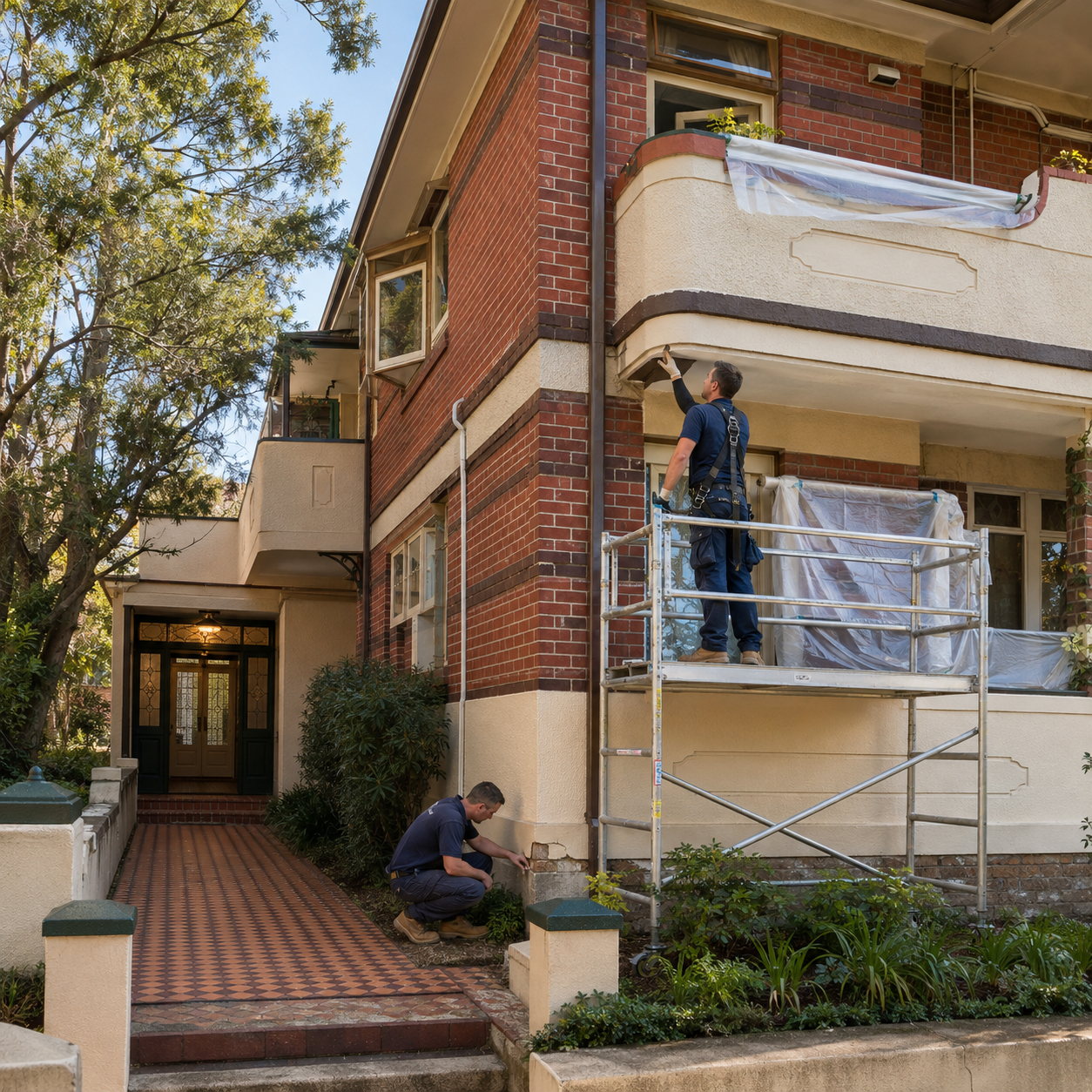
Older apartment buildings are part of the character of Sydney's Inner West. Red-brick walk-ups, Art Deco blocks, converted industrial buildings and compact mixed-use schemes sit throughout Balmain, Rozelle, Annandale, Leichhardt, Petersham, Stanmore, Marrickville, Newtown, Ashfield and surrounding suburbs. Their age and construction can also create a distinctive maintenance challenge for owners corporations.
A recurring leak may begin at a roof junction and appear two levels below. Original galvanised pipes may fail behind a wall shared by several lots. Balcony membranes, brickwork, windows, concrete and stormwater systems can reach the end of their service life at different times. When access is tight and residents remain in occupation, even a straightforward repair may need careful investigation, approvals, funding, communication and supervision.
This guide explains how to approach strata repairs in Inner West Sydney apartment buildings: what may be common property, the repair issues that frequently arise in older schemes, the owners corporation's NSW obligations, and a practical process for progressing work. It is designed for owners and committees who want to move from repeated patching to informed, properly planned decisions.
What is common property in an Inner West strata building?
Common property generally comprises the parts of the parcel that are not included in an individual lot. The registered strata plan, relevant legislation and the scheme's by-laws are the starting points for determining the boundary in a particular building. Renovations, exclusive-use by-laws and earlier resolutions can also affect responsibility, so it is risky to decide ownership from the visible location of a defect alone.
NSW Government guidance identifies common examples that are usually maintained by the owners corporation, including roofs and gutters, boundary walls, concrete slabs, common-area carpets and lights, garages, balconies and balcony doors, windows and locks, and plumbing located in boundary walls or below the floor. Water damage caused by a failure of common property may also be an owners corporation issue. The facts and strata plan still need to be checked for each scheme.
Common property repair or lot-owner repair?
A leaking pipe inside a boundary wall may be common property, while a tap, fitting or appliance serving only one lot may be the lot owner's responsibility.
A balcony slab or original waterproofing membrane may be common property, but tiles or alterations installed by an owner can complicate responsibility.
Original windows are commonly treated as common property in many schemes, but the strata plan, by-laws and any approved replacement work should be reviewed.
Damage inside a lot and the building component that caused it are separate questions. The repair pathway may involve the owners corporation, a lot owner and the insurer in different capacities.
Where responsibility is unclear, the committee should obtain the strata plan, by-laws, renovation approvals and available maintenance records before authorising substantial work. A strata manager can coordinate those records and the decision process, but a surveyor, lawyer, engineer or other qualified professional may be needed to resolve a technical or legal boundary question.
Why older Inner West apartment buildings need a repair strategy
Age does not automatically mean a building is defective, and a well-maintained older block can perform very well. The difficulty is that materials and building services have finite lives. A scheme that reacts only when something fails can experience repeated call-outs, inconsistent scopes, special levies and disruption. A documented strategy lets the owners corporation distinguish urgent repairs from planned renewal and budget accordingly.
Inner West projects can also be shaped by the local setting. Narrow streets, limited loading zones, small driveways, adjoining terraces, busy retail frontages and occupied units can influence scaffolding, waste removal, deliveries and resident access. Heritage listings, conservation areas or council controls may affect some external works. These matters are project-specific and should be confirmed with the relevant consultants and approval authorities before work begins.
Seven common repair issues in older Inner West strata schemes
1. Water ingress and recurring leaks
Water ingress is a symptom, not a diagnosis. Moisture around a ceiling or window may originate from roofing, flashings, parapets, cracked render, failed sealants, balcony membranes, plumbing, overflowing gutters or surface drainage. Treating the visible stain without identifying the entry path often leads to repeated repairs.
A sound strata waterproofing process starts with photographs, dates, weather conditions and affected locations. Leak detection, controlled testing or an inspection by an appropriately qualified consultant may then be required. The repair scope should address the source and any resulting damage, with a clear method for testing the work before final payment.
2. Ageing water, waste and stormwater pipes
Older buildings may contain a mix of original and replacement pipework. Corrosion, joint failure, movement, blockages and previous piecemeal repairs can make fault-finding difficult. Before approving a major pipe replacement, the owners corporation should understand which lots and common areas are served, where the relevant boundary lies and whether a sectional repair or coordinated renewal offers better value.
Drainage deserves particular attention. Inadequate falls, cracked lines, tree roots, undersized outlets or poorly maintained pits can contribute to ponding and water entry. CCTV inspections, hydraulic advice or a drainage plan may be more useful than repeatedly clearing the same blockage.
3. Roofs, gutters, flashings and parapets
Roof systems work as a whole. Tiles or metal sheeting, membranes, gutters, downpipes, flashings, penetrations and parapet cappings all need to direct water safely away from the building. Debris, corrosion, cracked pointing and incompatible past repairs can create local failures that are hard to see from ground level.
For strata roof repairs in the Inner West, safe access and an appropriate inspection are essential. The scope should distinguish maintenance—such as cleaning and minor sealing—from component replacement or a larger roof renewal. Where solar panels, aerials, air-conditioning equipment or owner installations are present, access and responsibility should be resolved before contractors commence.
4. Balconies, membranes and balustrades
Balcony defects can affect the lot, the facade and the property below. Common issues include failed membranes, cracked tiles, inadequate falls, blocked outlets, corroded balustrade fixings and movement at door thresholds. Replacing surface tiles alone may not solve a membrane or drainage problem.
Balcony repairs in a strata building often require a coordinated design, demolition controls, waterproofing installation, testing and reinstatement. Safety, falls, balustrade compliance, door interfaces and damage to adjoining areas may all need professional input. If several similar balconies are showing the same symptoms, a building-wide investigation may be more efficient than treating each one as an isolated claim.
5. Brickwork, render, windows and facades
Older brick and rendered facades may show cracking, fretting mortar, failed sealants, corrosion around lintels or water entry at windows. The visible crack is not always the cause, and cosmetic patching can hide movement or trap moisture. A qualified assessment should determine whether the issue is local deterioration, water management, structural movement or a combination.
External remedial building work in Sydney may require scaffolding, swing-stage access, council permits or coordination with neighbours. A consistent facade scope can reduce mismatched repairs and repeat mobilisation costs. The committee should also confirm whether proposed window or facade changes affect the building's appearance, planning controls or existing by-laws.
6. Concrete deterioration and corrosion
Cracked or spalling concrete can occur where moisture reaches reinforcing steel and corrosion expands beneath the surface. Symptoms may include rust staining, drummy areas or pieces breaking away from balconies, eaves, stairs or basement elements. Loose material can create an immediate safety risk, while the underlying deterioration needs a properly designed repair.
The first step is to make any unsafe area secure, then obtain suitable engineering or remedial advice. A durable concrete repair usually involves more than filling the surface. The cause, reinforcement condition, repair material, protective treatment and extent of affected areas should be addressed in the scope.
7. Shared services, fire safety, lifts and access
Common electrical infrastructure, intercoms, pumps, fire-safety measures, lifts and access systems require ongoing maintenance and eventual renewal. In an older building, documentation may be incomplete and upgrades may need to work around limited plant space or obsolete equipment. Committees should keep service reports together, track recurring faults and connect likely renewal costs to the capital works plan.
The NSW duty to repair and maintain common property
Section 106 of the Strata Schemes Management Act 2015 requires an owners corporation to properly maintain and keep common property in a state of good and serviceable repair, and to renew or replace fixtures and fittings comprised in common property. The duty is held by the owners corporation. A strata committee can progress decisions within its authority, while the appointed strata manager acts under the legislation, agency agreement and delegated functions.
Waiting indefinitely because responsibility is disputed, funds are limited or recovery action is being considered can expose the scheme to greater damage and cost. NSW guidance says delay while pursuing a builder, developer or other responsible party must not negatively affect building safety or access and use. Where urgent risk exists, temporary safety measures and an appropriate decision pathway should be put in place promptly.
From 27 October 2025, NSW Fair Trading received stronger powers relating to strata common property repairs. Depending on the circumstances, it can investigate complaints and seek outcomes including a rectification plan, a compliance notice or an enforceable undertaking. Owners still have access to the scheme's motion process, mediation and the NSW Civil and Administrative Tribunal pathways where appropriate.
Maintenance, repair, renewal or improvement?
These labels matter because the required approvals can differ. Routine servicing and like-for-like repair may fall within existing maintenance authority. Renewal can involve replacing an exhausted component. An alteration, addition or material change to common property may be an improvement and can require a general-meeting resolution or by-law. Major works can combine all four elements.
Do not rely only on the contractor's description of a job as a repair. Before committing the owners corporation, confirm the legal approval, the technical scope, who can sign the contract, how the work will be funded, and whether planning, building or other approvals apply.
A practical common property repair workflow
Report and document the problem. Record the date, location, photos, weather or operating conditions, affected lots and any immediate safety issue. Keep reports in one central repair record rather than across personal email chains.
Triage urgency. Protect people and property first. Isolate services, restrict unsafe access or arrange emergency attendance where genuinely necessary, then document the action and cost.
Confirm ownership and authority. Review the strata plan, by-laws, prior renovations and relevant resolutions. Identify whether the committee, owners corporation or a lot owner must approve the next step.
Investigate before scoping. Use an appropriately licensed trade or qualified consultant to diagnose the cause. Complex waterproofing, structural, facade, fire or building-services work may require specialist design or regulated practitioners.
Prepare a comparable scope. Define inclusions, exclusions, access, protection, testing, disposal, making good, warranties and completion documents so quotations can be assessed on the same basis.
Obtain quotations and approve procurement. NSW guidance requires all schemes to obtain at least two independent quotes for work valued at $30,000 or more, except emergency repairs. For lower-value work, competitive quotes can still be prudent depending on urgency, risk and the scheme's policies.
Confirm funding. Check the administrative and capital works fund budgets, the 10-year plan and available cash flow. Options may include regular contributions, a special levy, a strata loan or a combination approved through the proper process.
Communicate access and disruption. Give residents practical notice about dates, working hours, water or power shutdowns, noise, dust, parking, balcony clearance and contact arrangements. Allow extra planning where tenants, businesses or vulnerable residents may be affected.
Administer and monitor the work. Confirm licences, insurance, contract terms and approvals. Track variations, consultant inspections, progress claims and defects against the approved scope rather than relying on verbal instructions.
Close out the project. Inspect before final payment, obtain warranties, certificates, manuals, photographs and as-built information where relevant, and update the repair register and capital works plan.
Quotes, contracts and professional advice
The cheapest quote is not necessarily the best value if it omits access, investigation, protection, testing or reinstatement. Committees should compare the proposed method, contractor capability, exclusions, program, warranty and price. For complex projects, a consultant-prepared scope and tender assessment can make the quotations genuinely comparable and reduce variation risk.
Contract requirements depend on the nature and value of the work. NSW Government repair guidance points schemes to appropriate residential building contracts and notes that complex building work may involve obligations under the Design and Building Practitioners framework. The owners corporation should obtain project-specific advice where the correct contract, design obligations or statutory approvals are uncertain.
Funding repairs through the 10-year capital works plan
Every strata scheme needs a 10-year capital works fund plan. In an older Inner West apartment building, the plan should be more than a generic schedule. It should reflect the actual roof, facade, balconies, drainage, services, fire systems, lift, access equipment and known remedial issues, together with realistic timing and updated cost estimates.
From 1 April 2026, a prescribed NSW standard form applies when a scheme revises an existing 10-year plan or replaces a plan that has been in place for 10 years. NSW's Strata Building Repairs Health Check recommends reviewing the plan at least once within the required five-year cycle and checking whether the capital works fund will cover forecast work. A condition report or specialist input may be needed where major assets are poorly documented.
Unexpected work can still arise. NSW guidance identifies special levies, strata loans, regular levies or a mix as possible funding approaches. If emergency common property repairs require a levy, the due date can be as short as 14 days. Transparent explanations, staged cash-flow forecasts and early owner communication are particularly important when a substantial contribution is proposed.
Repairs, maintenance and strata insurance
Strata insurance is not a substitute for maintenance. A policy may respond to defined insured damage while excluding the worn, defective or deteriorated component that caused it. The owners corporation may need to repair the source, coordinate access and provide documents even where an insurance claim is lodged.
NSW's repairs health check warns that neglected maintenance can lead to higher premiums or excesses, reduced cover, fewer insurer options or insurance becoming unavailable. Accurate repair records, completed recommendations and current valuations can help the scheme demonstrate how risk is being managed. Committees should review coverage, exclusions and claim strategy with qualified insurance advisers rather than assuming every leak or failure is insured.
Inner West project planning: practical local considerations
Access and logistics: confirm scaffold positions, loading zones, waste handling, parking, lift use and protection of narrow common areas before tendering.
Neighbours and mixed use: consider party boundaries, retail trading, shared access and noise or dust impacts where the building adjoins homes or businesses.
Planning controls: check whether council approval, heritage input, permits or other consent may be needed for external changes or occupation of public space.
Occupied lots: plan notices, keys, appointments, security and making good across owners, tenants and managing agents.
Consistent building appearance: coordinate visible window, balcony, paint, brick and facade work rather than allowing incompatible one-off solutions.
Coastal and urban exposure: allow for rain, heat, pollution and salt carried inland when consultants specify materials and maintenance cycles for the actual site.
Common committee mistakes to avoid
Repeatedly patching symptoms without diagnosing the source of the defect.
Assuming the person who reports damage is automatically responsible for the failed building component.
Seeking prices before there is a written, comparable scope of work.
Delaying safety or access measures while insurance, builder recovery or responsibility is disputed.
Approving work informally without confirming the resolution, budget, delegation and contract signatory.
Failing to budget for access, consultants, approvals, testing, resident protection and making good.
Paying the final claim before inspections, defects, warranties and close-out records are complete.
Leaving completed repairs out of the maintenance history and 10-year capital works fund plan.
Older-building repair readiness checklist
Keep the current strata plan, by-laws and renovation approvals together and accessible.
Maintain a repair register showing reports, decisions, invoices, warranties and recurring locations.
Review the 10-year capital works fund plan against actual building condition and recent quotes.
Record urgent-risk contacts and the committee's emergency decision process.
Use licensed contractors and qualified consultants appropriate to the work.
Require a written scope, approvals, funding and contract before non-emergency work starts.
Plan resident access and communications before confirming the construction program.
Capture warranties, certificates, photos and maintenance instructions at completion.
How ETSM helps Inner West owners corporations
ETSM provides owner-led strata management for apartment buildings across Sydney's Inner West, Eastern Suburbs and Lower North Shore. Our approach combines a named, accountable strata manager with administration, accounting and senior support, so committees have a clear contact while the scheme's records and routine work are supported by a wider team.
For common property repairs, ETSM can help log reports, retrieve plans and by-laws, obtain committee or general-meeting instructions, coordinate licensed trades and independent consultants, arrange quotations, communicate access, monitor approved actions and keep project records available through secure online access. The owners corporation makes the required decisions, and technical professionals determine specialist scopes and certifications.
Our routine management fees are designed to be transparent and inclusive, without insurance or trade commissions. If your building in Balmain, Rozelle, Leichhardt, Petersham, Stanmore, Marrickville, Newtown, Ashfield, Summer Hill or another Inner West suburb is dealing with recurring repairs—or wants to plan before the next failure—ETSM can prepare a tailored strata management proposal.
Frequently asked questions
Who is responsible for common property repairs in NSW strata?
The owners corporation has the statutory duty to maintain and repair common property. Whether a particular pipe, window, balcony component or wall is common property depends on the registered strata plan, legislation, by-laws and relevant alterations. Check the documents before allocating responsibility.
Are balcony repairs the owners corporation's responsibility?
Balconies and balcony doors are common-property examples in NSW Government guidance, but responsibility can depend on the plan, the failed component and any owner renovation or exclusive-use by-law. The membrane, slab, tiles, balustrade and door should be considered separately.
Does strata insurance pay for a leaking roof or failed waterproofing?
A policy may cover resulting damage from an insured event but may not pay to replace a worn, defective or poorly maintained component. The scheme should stop further damage, identify the cause and check the policy and insurer requirements with qualified advisers.
How many quotes are required for strata repairs in NSW?
NSW Government guidance says all schemes must obtain at least two independent quotes for work valued at $30,000 or more. Emergency repairs are an exception. Competitive quotations can still be sensible below that threshold, depending on risk and urgency.
Can a strata committee approve major repair work?
It depends on the nature of the work, the scheme's delegations, budget and the resolution required. Some work can be approved by the committee, while major spending, funding, common-property alterations or contracts may need an owners corporation resolution at a general meeting.
What should happen when water is leaking into an apartment?
Report and photograph it promptly, protect people and property, and arrange urgent attendance if needed. The scheme should identify the source rather than only repairing internal damage, then confirm responsibility, scope, funding and access.
Can an owners corporation delay repairs while pursuing a builder or insurer?
A scheme can pursue recovery or an insurance claim, but NSW guidance says delay must not negatively affect building safety or access and use. Temporary safety work or repairs may need to proceed while liability is resolved.
How should older apartment buildings budget for repairs?
Use a building-specific 10-year capital works fund plan, current condition information and realistic cost estimates. Regular levies, special levies, a strata loan or a combination may be used through the correct approval process.
Why use a strata manager for remedial work?
A strata manager can organise records, decisions, quotations, meeting papers, contractor access, communications and approved payments. The manager coordinates the process; engineers, building consultants and licensed contractors remain responsible for specialist investigation, design and work.
Suggested calls to action
Managing recurring leaks or ageing common property? Ask ETSM for a practical strata management proposal tailored to your Inner West building.
Planning roof, balcony, facade or pipework repairs? Talk to ETSM about a clearer governance, quotation and communication process.
Considering a change of strata manager? Send ETSM your current agreement and building priorities for a confidential initial discussion.
The following official resources support the legislative and procedural information in this article:
NSW Government – Strata repairs and maintenance
NSW Government – Strata Building Repairs Health Check
NSW Government – Guide to strata law changes for committees and owners
NSW Government – Safety rules for strata common property
NSW Government – Stronger repair enforcement powers
NSW Legislation – Strata Schemes Management Act 2015
General information only. This article is current to 19 August 2026 and is not legal, engineering, building, insurance or financial advice. Common property boundaries, approvals, statutory obligations and repair solutions depend on the scheme and the work. Owners corporations should check current NSW Government guidance and obtain appropriately qualified advice for their circumstances.