Narooma and Bermagui Strata Roof Maintenance: Salt, Storms, Gutters and Water Entry
A coastal maintenance guide for committees in Eurobodalla and the Bega Valley
Prepared for Essential Strata Management | Nsw South Coast
Narooma and Bermagui Strata Roof Maintenance: Salt, Storms, Gutters and Water Entry
On the South Coast, a roof can look sound from the driveway and still be developing a costly problem. Salt settles on flashings and fixings. Leaves collect behind a gutter outlet. Wind-driven rain finds a lap or penetration that stays dry in ordinary showers. A loose sheet or cracked tile shifts during a severe weather event. By the time a ceiling stain appears, water may already have travelled through insulation, framing or wall cavities.
For strata buildings in Narooma, Dalmeny, Kianga, Tilba, Mystery Bay, Bermagui and Wallaga Lake, roof care needs to be planned as a coastal asset-management task. It is not just an emergency response after a leak. An effective program combines safe inspections, cleaning, small repairs, good records, storm preparation and clear escalation when renewal is approaching.
This guide focuses on common property roof systems, gutters and water entry in coastal strata. It is not a substitute for a site inspection by a licensed roofer, plumber, engineer, building consultant or other appropriately qualified professional.
Why roofs on this stretch of coast need a local approach
Narooma and Bermagui are separated by less than an hour's drive, but a contractor still moves between two council areas and a range of exposed coastal settings. Narooma, Dalmeny and Kianga sit within Eurobodalla Shire. Bermagui, Wallaga Lake and Cobargo sit within Bega Valley Shire. Tilba and Mystery Bay add smaller communities and buildings that may be occupied seasonally.
- The roof risk is shaped by more than distance from the shoreline. Consider:
- exposure to salt-laden air and persistent coastal moisture;
- strong winds, wind-driven rain and debris during storms;
- east coast lows and other coastal systems bringing damaging winds and heavy rainfall;
- eucalyptus leaves, bark, pine needles and organic material entering valleys and gutters;
- UV exposure and thermal movement across metal roofs and sealants;
- holiday occupancy, when a leak can remain unnoticed between visits;
- limited access around sloping sites and tightly arranged townhouses; and
- regional contractor travel, scaffold availability and longer lead times after widespread storms.
The Bureau of Meteorology explains that east coast lows can bring damaging to destructive winds, heavy to intense rainfall, dangerous seas and heavy swell. They can occur throughout the year, even though late autumn and winter are a peak period. That makes a calendar based only on one traditional storm season inadequate. See the Bureau's guide to east coast lows and other lows.
Is the roof common property?
The NSW Government identifies roofs and gutters as typical owners corporation responsibilities. The owners corporation must maintain and repair common property, but every scheme should still check its strata plan, by-laws and any registered common property rights or renovation by-laws.
The boundary can become less obvious where an owner has installed a skylight, satellite dish, solar system, air-conditioning penetration or altered drainage. A townhouse scheme may have roof areas that serve one lot but remain common property. Exclusive use does not automatically transfer every maintenance obligation unless the by-law validly does so.
- Before authorising substantial work, confirm:
- which roof planes, gutters, downpipes and penetrations are common property;
- who approved any owner-installed item and what the by-law says about maintenance;
- whether an external wall, balcony or window is contributing to the reported water entry;
- whether the proposed response is a repair, renewal or alteration; and
- what access is required through lots or exclusive-use areas.
The NSW strata repairs and maintenance guide is a useful starting point. It states that owners corporations are generally responsible for roofs, gutters and water damage coming from common property.
Know the roof system before writing a maintenance schedule
A maintenance checklist should reflect the actual building. Narooma and Bermagui strata properties include tiled roofs, corrugated or standing-seam metal roofs, low-slope membranes, box gutters, simple eaves gutters, internal downpipes, parapets, awnings and mixed additions built at different times.
- Create a roof asset register containing:
- roof material and approximate installation date;
- manufacturer or system details where known;
- gutters, valleys, sumps, overflows and downpipe routes;
- flashings at walls, chimneys, skylights and penetrations;
- vents, aerials, solar panels and mechanical equipment;
- access points, anchor systems and known safety restrictions;
- previous leaks, repairs, warranties and photographs; and
- areas exposed to nearby trees, prevailing weather or ponding.
If records are incomplete, commission a baseline condition assessment. The aim is not to predict an exact failure date. It is to identify the components, condition, immediate defects, maintenance tasks and likely renewal horizon so the capital works plan is based on evidence.
Salt exposure: what to inspect
Salt and moisture increase the corrosion risk for susceptible metals. The pattern is often uneven. Sheltered areas that do not receive regular rain washing can retain deposits. Cut edges, fasteners, dissimilar-metal junctions and scratched coatings can become early trouble points. Gutters that hold wet debris create a different exposure from a clean, freely draining roof sheet.
Inspect for:
- surface rust, pitting, blistering, chalking or coating breakdown;
- corroded fasteners, washers, brackets and gutter supports;
- staining around sheet laps, flashings and penetrations;
- contact between incompatible metals;
- swarf or metal fragments left from previous drilling or cutting;
- damaged sealant or protective coating at cut edges;
- persistent wet debris and ponded water; and
- corrosion concealed beneath solar rails, plant supports or leaf guards.
Do not specify cleaning chemicals, coating systems or replacement metals by guesswork. Check the roof and rainwater-product manufacturer's guidance, coastal exposure limitations and warranty conditions. Aggressive washing or incompatible chemicals can damage coatings. A licensed roofing professional should recommend the method and confirm safe access.
Gutters, valleys and downpipes: small blockages, large consequences
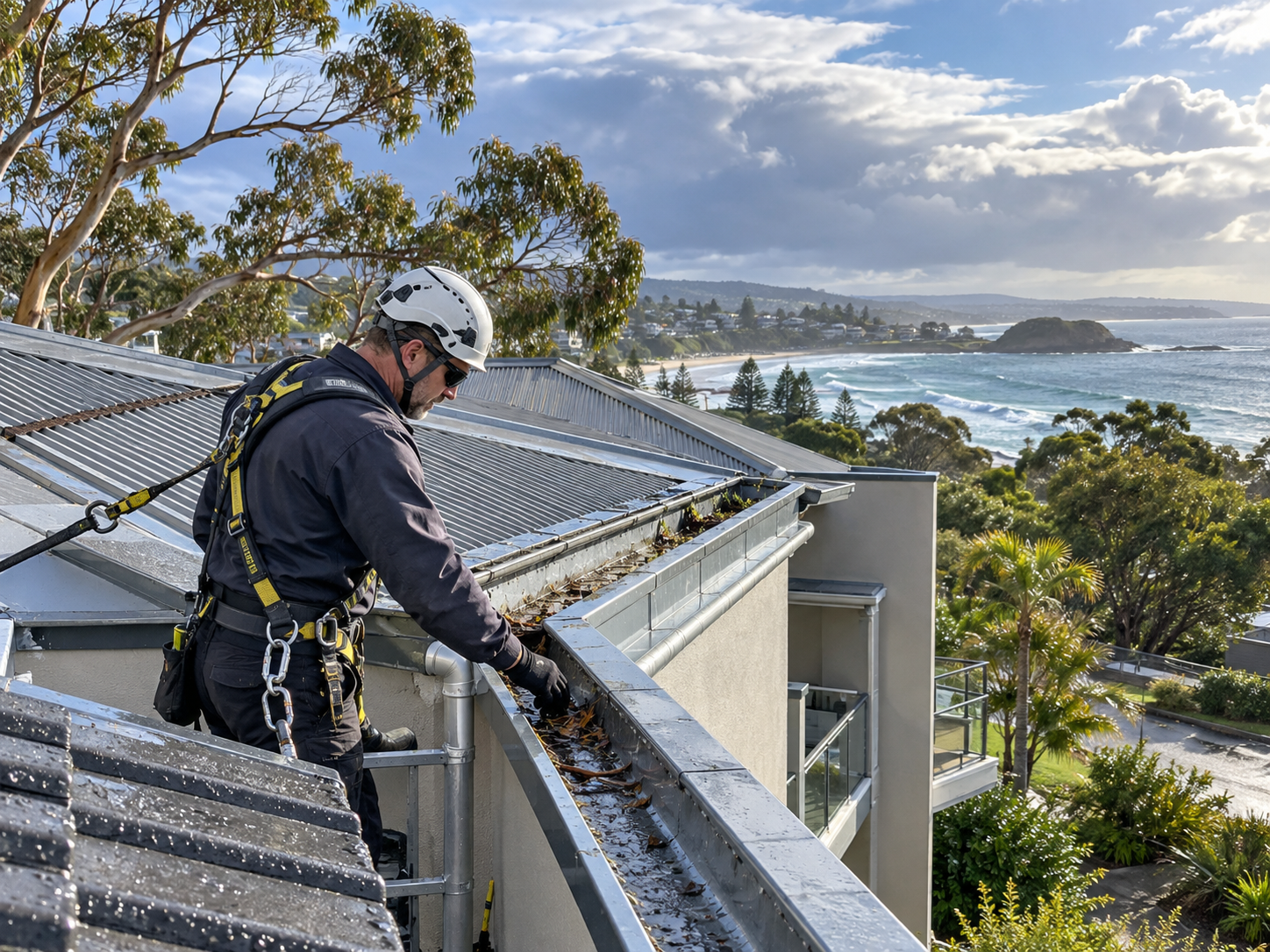
NSW SES advises property owners to clear gutters, downpipes and drains regularly because blockages can trap water and cause overflow under eaves. In strata buildings, the consequence can extend beyond one ceiling. Water may enter several lots, common stairwells, electrical areas or wall systems.
A complete rainwater-path inspection follows water from the highest collection point to a lawful discharge location. Check:
- roof valleys and behind penetrations;
- eaves and box gutters;
- sumps, outlets and overflow provisions;
- downpipe heads, joints and brackets;
- underground or concealed stormwater connections;
- evidence of backflow, surcharge or ponding;
- staining on façades and soffits; and
- erosion or discharge problems at ground level.
Leaf guards reduce some debris but do not make a system maintenance-free. Fine material can pass through, valleys can remain exposed and guards can conceal corrosion or slow drainage if poorly matched to the roof. Include safe removal or inspection of guards in the maintenance scope.
Frequency should be risk-based. A building beneath gums or pines may need more frequent cleaning than an open site. Inspection after strong winds can be more valuable than rigidly waiting for the next calendar date. Record what was removed and whether outlets, overflows and downpipes were flow-tested.
Wind-driven rain is not the same as a vertical leak
Water does not always enter directly above the stain. Wind can push rain upward beneath tiles, through laps, around parapet cappings or across a small flashing defect. Water can then travel along sarking, battens, pipes or framing before becoming visible.
The investigation should capture weather conditions when the leak occurs:
- wind direction and strength;
- rainfall intensity and duration;
- whether the leak appears immediately or hours later;
- which rooms, walls or ceilings are affected;
- whether a different elevation is wet; and
- whether the issue occurs in ordinary rain or only severe weather.
Photographs taken during the event can be valuable, but residents should never enter a roof space or climb onto a wet roof. A professional may use moisture mapping, controlled hose testing, roof-space inspection, thermal imaging or targeted opening. Testing should follow a documented method so water is not introduced indiscriminately and mistaken for the original defect.
Inspect after storms, but do it safely
Post-storm inspection should begin from the ground or another safe location. Look for displaced tiles, loose sheets, damaged cappings, fallen branches, sagging gutters, overflowing outlets and debris. Inside, check top-floor ceilings, common corridors, plant rooms and known historical leak points.
Do not send a caretaker, committee member or resident onto the roof simply because a contractor is unavailable. Wet roofs, damaged sheets and unstable edges create serious fall risks. Work at heights requires competent contractors, suitable access and controls. Even a low-rise complex can have unsafe roof geometry.
If there is active water near electrical equipment, a damaged power line, unstable roofing or a life-safety risk, keep people away and contact the appropriate emergency service or licensed trade. The NSW SES should be used for storm and flood emergency information, and Triple Zero is for life-threatening emergencies.
What a useful roof inspection report should contain
A report should help the committee make a decision, not merely list photographs. Ask the inspector to identify:
- roof areas and components inspected;
- areas that could not be safely accessed;
- observed defects and probable causes;
- immediate make-safe actions;
- maintenance items with recommended priority;
- repairs needing a defined scope and quotation;
- items requiring an engineer, plumber or specialist consultant;
- expected remaining serviceability, with qualifications;
- photographs tied to a roof plan where practical; and
- recommended review intervals.
Avoid accepting a one-line recommendation to replace the entire roof without a condition basis, but also avoid repeated patching when evidence shows broad system failure. The committee needs to understand whether the problem is local, systemic or uncertain pending further investigation.
Repair, patch or replace?
A local repair can be sensible when the surrounding system is sound and the defect is isolated. Replacement may be more economical when failures are widespread, materials are near end of service life, compatible components are unavailable, or repeated call-outs are damaging interiors.
- Compare options on whole-of-life grounds:
- Does the repair address the cause or only the visible symptom?
- How much of the roof is affected?
- Can new material be integrated without creating incompatible joints?
- What warranty applies to the repair and the surrounding old roof?
- Will access costs be repeated for the next likely defect?
- Can drainage, overflow or flashing weaknesses be corrected at the same time?
- What approvals or design work are required?
- How does each option affect the capital works plan?
For work valued at $30,000 or more, the NSW Government states that owners corporations must obtain at least two independent quotes, subject to the emergency-repair exception. Comparable quotes need a common scope. One price for patching and another for full replacement are options, not directly competing bids.
A seasonal maintenance program for Narooma and Bermagui
The schedule below is a framework. Adjust it for roof type, tree cover, exposure, occupancy and manufacturer requirements.
Routine observations
Residents, cleaners or the building manager can report visible overflow, debris, staining, loose items and ceiling changes from safe locations. Provide one reporting channel and ask for photographs, date, location and weather. Early reports should trigger triage, not automatic blame.
Planned professional inspections
Arrange a licensed or competent roof professional at intervals supported by the building's condition and risk. More exposed buildings, older systems and tree-covered sites may require closer attention. Include flashings, penetrations, coatings, tiles, sheets, gutters, overflows and downpipes in the scope.
Before forecast severe weather
Confirm known gutters and drains are clear, loose external items are secured, emergency contacts are current, access keys are available and residents know how to report water entry. Do not schedule rushed roof work in unsafe weather.
After severe wind or rain
Carry out safe external observations and inspect known internal risk areas. Record even minor displacement or new staining. Notify the insurer or broker promptly if there may be insured damage, while arranging reasonable measures to prevent further loss.
Annual review
Review the inspection history, leak register, repair spending, warranties and capital plan. If call-outs are increasing, commission a broader condition assessment rather than continuing isolated patches.
Regional contractor planning
South Coast committees should plan procurement before the first major leak. During a widespread storm, roofers, scaffolders, electricians, plumbers, drying specialists and assessors may all be busy. Travel between Batemans Bay, Narooma, Bermagui and Bega can add time and mobilisation cost. Specialised materials may not be stocked locally.
Maintain verified contractor details and understand:
- licence and insurance status;
- experience with the relevant roof system and coastal exposure;
- safe-access capability and height-work controls;
- emergency call-out coverage and travel charges;
- who can perform temporary make-safe work;
- how photographs and reports will be supplied; and
- whether the contractor can separate emergency work from permanent repair pricing.
Avoid depending on one person for every discipline. A roofer may identify a drainage concern that requires a roof plumber; structural movement may need an engineer; recurring water entry may need an independent building consultant. The strata manager coordinates the process but should not pretend to provide technical certification.
Council, approvals and neighbouring property
Maintenance that replaces like with like may be straightforward, while changes to roof form, drainage, structures, solar equipment or heritage elements may require additional approval. Narooma-area properties deal with Eurobodalla Shire Council; Bermagui-area properties deal with Bega Valley Shire Council. Planning controls and consent conditions are site-specific.
Before substantial replacement, confirm whether development consent, complying development, heritage review, stormwater approval or another permit is needed. Check whether scaffold or access will affect a public footpath, road reserve or neighbour. A contractor's ability to build the roof does not by itself confirm the owners corporation has every required approval.
Maintenance versus insurance
Strata insurance may respond to sudden, accidental storm damage, subject to the policy. It generally should not be treated as a maintenance budget for corrosion, wear, failed sealants, blocked gutters or gradual deterioration. A storm can also reveal an existing weakness, producing a claim where some items are accepted and others excluded.
After an event:
- photograph damage and water entry from safe locations;
- take reasonable steps to prevent further loss;
- notify the strata manager, broker or insurer promptly;
- retain damaged components if requested and safe to do so;
- separate emergency invoices from improvement work; and
- keep pre-event inspection and maintenance records.
Do not promise an owner that the insurer will replace internal finishes or pay accommodation before coverage is confirmed. Excesses, policy definitions, maintenance evidence and causation all matter. The insurer makes the coverage decision under the policy.
A local scenario: two leaks, one maintenance lesson
Consider a 12-lot coastal complex in Narooma with metal roofing, several box gutters and mature trees. After a southerly storm, one top-floor lot reports water at a window head and another reports staining near a hallway light. The committee assumes both leaks share one roof defect.
A safe inspection finds different causes. Wind-driven rain entered at deteriorated capping near the first lot. At the hallway, leaf material had restricted a box-gutter outlet and water reached an overflow path that had been partially obstructed by a past alteration. The contractor makes the area safe, the electrician checks the light circuit and the consultant documents permanent work.
The committee then updates the roof plan, records the alteration, introduces risk-based gutter cleaning and commissions a broader flashing review. It does not wait for the next storm or treat the two stains as proof that the entire roof needs immediate replacement. Evidence creates a proportionate response.
A Bermagui complex could face the same lesson with different logistics: contractor travel from Bega or Narooma, limited scaffold availability and holiday apartments that require access coordination. Local planning turns these practical constraints into the scope instead of discovering them after approval.
Water entry response checklist
- When a resident reports active water entry:
- Ask for the exact location, time, photographs and weather conditions.
- Keep occupants away from wet electrical fittings, bulging ceilings and unsafe areas.
- Contact the strata manager or approved emergency contact.
- Arrange licensed electrical isolation or assessment where needed.
- Use a competent contractor for safe make-safe work.
- Photograph affected common property, lot damage and temporary work.
- Notify the broker or insurer promptly if an insured event may be involved.
- Commission cause investigation, not only internal repainting.
- Dry affected materials and manage mould risk using suitable professionals.
- Approve the permanent scope through the owners corporation's process.
- Record the cause, work, warranty and future inspection requirement.
The detailed article on water leaks and waterproofing in Batemans Bay strata provides further guidance on responsibility and investigation without duplicating this roof-maintenance program.
Budgeting for roof maintenance and renewal
Routine cleaning and inspection usually belong in the administrative budget. Significant replacement, renewal or major repair generally needs capital works planning. The scheme's accounting advice and adopted budgets should determine the correct treatment.
Track annual reactive call-out cost as well as planned work. A roof that appears cheap because the replacement is deferred may be generating repeated internal repairs, drying, access and insurance excesses. Conversely, one isolated leak does not prove a serviceable roof needs wholesale replacement.
Use the condition report to update the 10-year capital works plan. Include consultant design, access, removal, temporary weather protection, hazardous materials, approvals and contingency where relevant. If funds are insufficient, start the funding discussion early so the committee is not trying to raise a large levy during a storm response.
How Essential Strata Management can support the process
A strata manager's role is to keep records, coordinate inspections and quotations, arrange meetings and approvals, communicate with owners, monitor invoices and update the maintenance history. Technical decisions should remain with qualified specialists, and insurance decisions remain with the insurer.
Essential Strata Management has local support through the Narooma office and works across the NSW South Coast. Committees managing intermittently occupied properties can also read the guide to vacant and holiday-owned South Coast apartments.
The practical goal is straightforward: know the roof, keep water paths clear, record changes, investigate the cause and plan renewal before repeated failures dictate the timetable.
Frequently asked questions
1. How often should a Narooma or Bermagui strata roof be inspected?
There is no single interval for every building. Base the program on roof type, age, condition, tree cover, coastal exposure, leak history and manufacturer guidance. Include planned professional inspections plus safe observations after significant wind or rain. Older, exposed or debris-prone roofs may need more frequent attention.
2. Who is responsible for strata roof and gutter repairs in NSW?
Roofs and gutters are generally common property maintained by the owners corporation. Check the strata plan, by-laws and approvals for owner-installed skylights, solar panels, aerials or other penetrations. Responsibility can be more complex where work was altered or an exclusive-use by-law applies.
3. Does a leaf guard mean gutters no longer need cleaning?
No. Fine debris can pass through, valleys and outlets can still block, and guards can conceal corrosion or trapped material. The maintenance scope should include safe inspection of the guard, gutter, outlet, overflow and downpipe, with cleaning at a frequency suited to the site.
4. Is every roof leak covered by strata insurance?
No. Coverage depends on the cause and policy. Sudden storm damage may be covered, while gradual deterioration, corrosion, poor maintenance or defective work may be excluded. Notify a potential claim promptly, preserve evidence and let the insurer or broker confirm coverage. Do not delay reasonable mitigation.
5. Can a committee member inspect the roof after a storm?
Committee members can make observations from a safe ground-level or internal position, but they should not climb onto a wet or damaged roof. Use competent contractors with proper access and height-safety controls. Keep people away from unstable roofing, wet electrical areas and bulging ceilings.
6. Why does water appear far from the roof defect?
Water can travel along sarking, framing, pipes, battens and ceiling surfaces before it becomes visible. Wind-driven rain may also enter a flashing or lap on another elevation. Record the weather and leak pattern, then use a structured professional investigation rather than repairing directly above the stain by assumption.
7. When should a roof be replaced instead of patched?
Replacement becomes more credible when defects are widespread, materials are near end of service life, compatible repairs are impractical, drainage or flashing design is broadly inadequate, or repeated call-outs are costly. A condition report should compare local repair, staged renewal and replacement on scope, risk and whole-of-life cost.
8. What records help with a storm damage claim?
Keep pre-event inspection reports, cleaning invoices, dated photographs, repair history, warranties, resident reports, weather timing, emergency invoices and post-event professional findings. Good records help separate existing deterioration from sudden damage and show that reasonable maintenance and mitigation occurred.
9. Do roof works need council approval?
Like-for-like maintenance may not require the same approvals as a changed roof form, structure, drainage system, solar installation or heritage alteration. Requirements are site-specific. Check with Eurobodalla Shire Council for Narooma-area properties or Bega Valley Shire Council for Bermagui-area properties, and obtain planning advice before substantial work.
Planning roof inspections, gutter maintenance or common-property repairs? Learn about our local strata management support for owners corporations in Narooma and Bermagui.
Authoritative external references
NSW Government: Strata repairs and maintenance
NSW SES: Storm and flood preparation
Bureau of Meteorology: East coast lows and other lows
Publication note and disclaimer
This article provides general information current at 17 September 2026. It is not legal, engineering, roofing, plumbing, work health and safety, planning or insurance advice. Roof systems, strata plans, by-laws, policies, approvals and site conditions differ. Use licensed and appropriately qualified professionals, follow safe-access requirements and check every linked source immediately before publication.