
Flooding and Stormwater Risks for Inner West Strata Buildings
Drainage, common property and emergency planning in Marrickville, Dulwich Hill and Lewisham
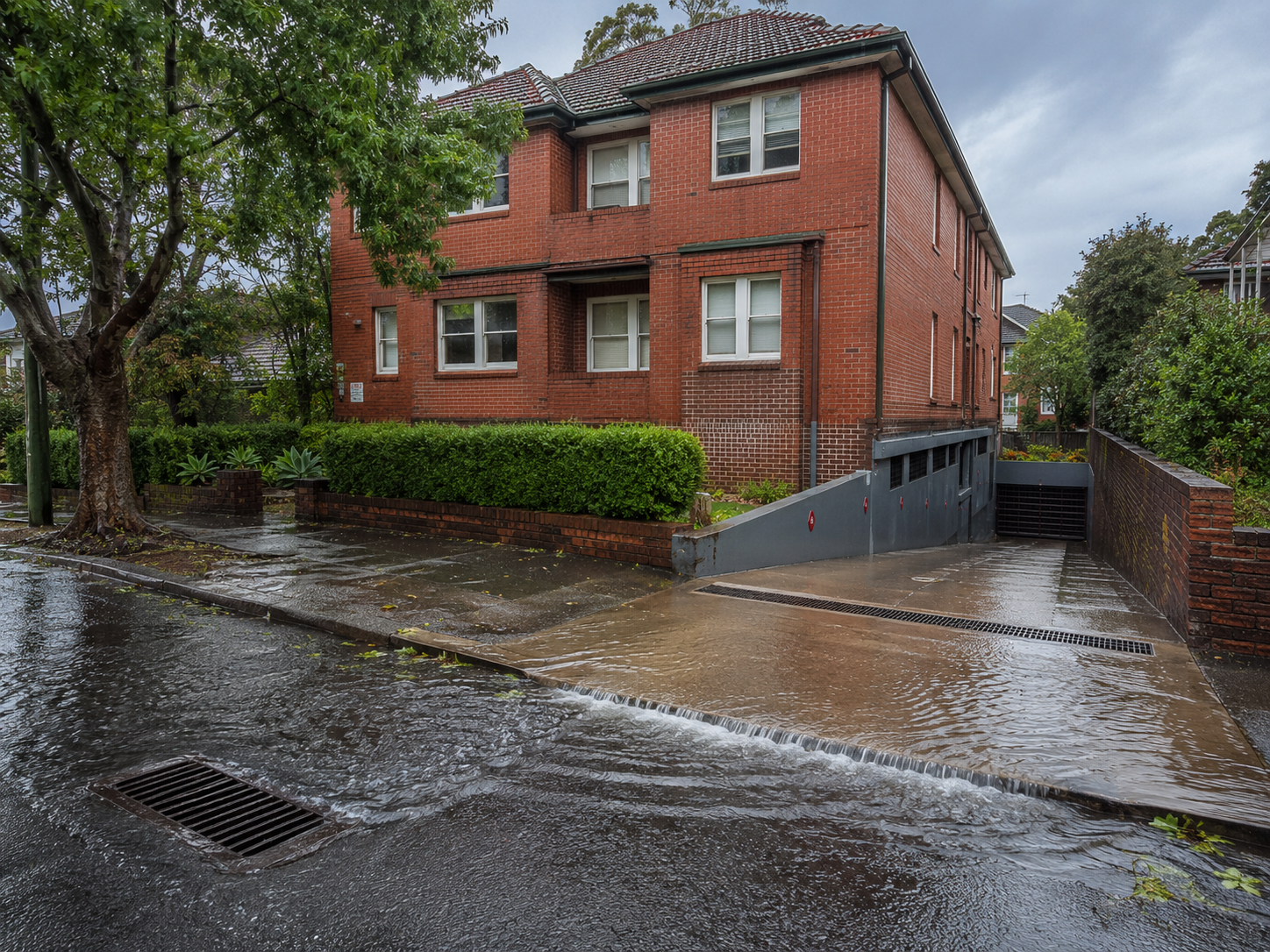
Flooding and stormwater risks for strata buildings in Marrickville, Dulwich Hill and Lewisham deserve more than a last-minute response when severe rain is already falling. In a dense, heavily paved part of Sydney, water can move quickly from roofs, streets and neighbouring land toward low points, basement ramps, courtyards, subfloors and ground-floor entries. A blocked pit, failed pump or unclear emergency contact can turn a short storm into a large repair, access and insurance problem.
Inner West Council explains that local flooding is generally flash flooding: sudden flooding that can occur within six hours of the rainfall that contributes to it. Council identifies the age of the stormwater system, local topography, intensive urban development and major waterways as factors in flood behaviour across the local government area.
This does not mean every building in Marrickville, Dulwich Hill or Lewisham has the same exposure. Risk can change from one side of a street to the other and between the front and rear of a site. The practical job for an owners corporation is to understand the building's actual water paths, maintain common-property drainage, plan for failure points and keep residents informed.
THE CENTRAL PRINCIPLE Stormwater follows levels, not lot boundaries. A strata plan may divide legal responsibility, but the investigation must follow the water from its source, across the site and into the drainage network.
1. Why Inner West flash flooding can challenge strata buildings
Sydney Water explains that hard surfaces such as roofs, roads and footpaths stop rainfall soaking into the ground. That runoff moves through property drains, council gutters and larger pipes, channels and creeks. In older, highly urbanised neighbourhoods, several flows can arrive at a building at once: roof water, street runoff, water from higher adjoining land and surcharge from overwhelmed on-site drainage.
Inner West Council groups the area into primary catchments. Marrickville is identified within the Marrickville Valley catchment. Parts of Dulwich Hill and Lewisham sit in the Hawthorne Canal catchment. Council is also preparing a Marrickville South flood study covering southern Dulwich Hill and south-west Marrickville, using modelling and community evidence including the February 2022 and April 2024 storm events.
LOCAL LENS, WHAT A STRATA COMMITTEE SHOULD TAKE FROM IT,
Marrickville Valley
A building may be influenced by local overland flow routes and the wider system draining toward the Cooks River. Confirm site levels, historical incidents, pits and the legal discharge point.
Hawthorne Canal
Relevant to parts of Dulwich Hill and Lewisham. Check whether the scheme sits near a low point, channel, mapped flood area or street flow path; do not infer risk from suburb alone.
Marrickville South study area
Current study work covers southern Dulwich Hill and south-west Marrickville. Committees should retain incident evidence and check for updated Council outputs before future major drainage works.
2. Where stormwater enters or damages a strata scheme
Water damage is often described simply as "flooding", but the entry path matters. A committee needs evidence showing whether water came over a threshold, through a failed membrane, from a blocked common drain, through a wall, down a lift shaft, from a private alteration or from the public drainage system.
RISK POINT, WHAT CAN GO WRONG, USEFUL CHECK
Roof, gutters and downpipes
Overflow, corrosion, poor falls, disconnected joints or leaf blockage can direct water into eaves, walls and lower courtyards.
Inspect outlets, overflows, flashings, spreaders and discharge during or immediately after safe rainfall conditions.
Basement garage ramp
Street or driveway runoff can cross the threshold faster than the trench drain, pit and pump can remove it.
Check ramp falls, grated drain capacity, sump, pump duty, power supply, alarm, backup and safe access.
Pits and underground pipes
Silt, roots, debris, collapse, poor connection or undersized components can cause surcharge at the lowest opening.
Clean and CCTV-inspect where justified; record pipe route, diameter, condition and lawful discharge point.
Courtyards and podiums
Blocked balcony or courtyard outlets can pond against doors and walls or load waterproofing beyond its intended service condition.
Check leaf guards, accessible overflows, membrane upturns, thresholds and owner-installed decking or planters.
Retaining walls and subfloors
Groundwater and surface runoff can build hydrostatic pressure or create persistent dampness and mould conditions.
Use building and drainage specialists to distinguish surface water, groundwater, plumbing leaks and waterproofing failure.
Lift pits and electrical rooms
Low service spaces can be damaged before water is obvious elsewhere, creating safety and access problems.
Keep plant-room thresholds, drainage, detection and emergency isolation procedures within the building risk plan.
3. Who is responsible for stormwater repairs in NSW strata?
Section 106 of the Strata Schemes Management Act 2015 requires an owners corporation to properly maintain and keep common property in good and serviceable repair. NSW Government guidance identifies roofs, gutters, boundary walls, concrete slabs, garages, common-property plumbing and water damage coming from common property as matters commonly handled by the owners corporation.
That general rule does not answer every claim. The registered strata plan, consolidated by-laws, adopted common-property memorandum, alteration approvals, cause of damage and insurance position must be reviewed. An owner-installed deck, tiled courtyard, enclosure or drainage alteration may carry a maintenance covenant. A public street pit may be a council or Sydney Water asset, while the building's private pipes and protection measures remain a separate question.
ITEM OR SITUATION, LIKELY FIRST ACTION
Original common-property roof drainage, shared pits or basement pump
Owners corporation investigates, makes safe and scopes maintenance or repair, subject to the plan and records.
Water entering from a lot fixture or lot-only plumbing
Notify the owner or agent and confirm source; common-property consequential damage may still need separate consideration.
Owner alteration affecting drainage or waterproofing
Locate the approval and by-law, confirm the installed work and determine any maintenance or indemnity obligations.
Street runoff or blocked public asset
Report the incident to the relevant authority and preserve evidence; also assess whether lawful on-site mitigation is required.
Internal contents, floating floors or personal property
Owner or occupier should notify their own insurer where applicable; the source repair and consequential loss are separate issues.
DO NOT ALLOCATE BLAME FROM THE WET LOCATION Water can travel behind walls, under floors and along slabs. The place where staining appears is evidence, but it is not proof of the failed component or legal responsibility.
4. Managing flooding and stormwater risks for strata buildings
The strongest flood-preparedness program combines records, physical maintenance and a rehearsed response. A committee does not need to wait for a major capital project before improving resilience.
Map the site. Record high and low points, roof discharge, driveway and courtyard falls, pits, pipes, overflows, pumps, nearby channels and any observed overland flow route.
Build the incident history. Collect dates, rainfall timing, photographs, videos, water depths, affected rooms, pump behaviour, contractor findings, insurance correspondence and previous repair scopes.
Inspect before storm season. Clean common gutters, grated drains and pits; test pumps and alarms; confirm isolation switches and emergency access.
Define the trigger. Decide who monitors Bureau and NSW SES warnings, who can engage emergency trades, who communicates with residents and where urgent records will be stored.
Plan for vulnerable residents and access. Consider ground-floor lots, basement parking, mobility needs, pets, remote owners and tenants who may not receive committee-only messages.
Fund known risks. Add pump replacement, drainage investigation, waterproofing, electrical protection and professional design to the capital works plan where evidence supports them.
Verify completed work. Keep CCTV footage, designs, approvals, as-built information, test results, warranties and the next maintenance date.
5. A practical stormwater maintenance schedule:
TIMING, PRACTICAL ACTION
Before forecast heavy rain
Clear accessible common grates and drains without entering confined spaces; test pumps and alarms; secure loose items; confirm emergency numbers and resident notice.
Quarterly or risk-based
Inspect basement ramps, pits, pump wells, non-return devices, roof drainage and known ponding points. Frequency should reflect the building and contractor advice.
Six-monthly
Review gutters, downpipes, roof outlets, flashings, courtyard drains, retaining-wall seepage and vegetation or leaf loads.
After any significant incident
Photograph water paths, obtain contractor findings, record water levels and pump operation, notify insurers promptly and review whether the plan worked.
Annually
Review the emergency contacts, delegations, insurance wording, maintenance contracts, capital works allowances and resident communication list.
Before major works
Use hydraulic, civil, structural, electrical, waterproofing or building advice appropriate to the proposed solution; check strata, council and certification approvals.
6. What to do when severe rain is forecast
BEFORE, DURING & AFTER
Monitor official Bureau and NSW SES warnings. Check drains and pumps from a safe location. Move vehicles or stored goods only when safe and authorised. Send residents a concise building-specific update.
Keep people away from fast-moving water, open drains, lift pits and electrical hazards. Never enter floodwater or a confined stormwater space. Call 000 for life-threatening emergencies and NSW SES on 132 500 for flood or storm assistance.
Make the area safe, document the water path before clean-up where possible, notify the strata manager and relevant insurers, arrange licensed electrical or building checks, and record every temporary repair.
SAFETY FIRST Do not ask a caretaker, committee member or resident to lift grates, enter a pit, approach energised equipment or walk through flowing water. Sydney Water warns that stormwater assets can rise quickly and contain dangerous pollutants.
7. Capital works that may reduce repeat damage
Where maintenance alone is not enough, an owners corporation may need a professionally designed mitigation project. Depending on the site, options can include increased inlet capacity, improved surface falls, additional overflows, pump redundancy, high-level alarms, raised thresholds, diversion drainage, waterproofing repairs, electrical protection or on-site detention upgrades.
A visible barrier is not automatically a safe solution. Work must not create an access hazard, obstruct required drainage, interfere with fire egress, overload another part of the system or unlawfully direct water to adjoining land. Major changes can require hydraulic or civil design, strata approval, council consent or certification. The scope should distinguish maintenance, defect rectification, betterment and emergency work.
8. Insurance preparation before the next storm
Do not assume that every form of water entry is defined the same way under a strata insurance policy. "Flood", stormwater runoff, rainwater entry, actions of the sea, gradual deterioration, defects and maintenance exclusions can be treated differently. The committee should ask its broker or insurer to explain the current policy wording and claims process for the building's known scenarios.
Keep the current policy schedule, product disclosure statement, valuations and broker contact details accessible.
Photograph plant rooms, pumps, basements, storage areas and known risk points before an incident.
Retain maintenance invoices, test records, reports and evidence that earlier recommendations were addressed.
After damage, separate urgent make-safe work from permanent repair and obtain written contractor findings.
Do not discard damaged items or authorise large non-urgent works before checking insurer requirements, unless safety demands immediate action.
9. Three illustrative Inner West scenarios
IMPORTANT These scenarios are illustrative and do not describe named ETSM clients. Replace them only with verified facts and permission.
ILLUSTRATIVE SETTING, HOW A WELL-MANAGED RESPONSE WORKS
Marrickville basement garage
During short, intense rain, water crosses a low driveway threshold and the pump alarm activates. The committee preserves video, checks the pump log and obtains a hydraulic assessment of ramp runoff, inlet capacity, sump storage, discharge and power resilience before approving upgrades.
Dulwich Hill rear courtyard
Water ponds against two ground-floor doors after leaves block a shared grated drain. The immediate blockage is cleared safely, but the scheme also maps roof and courtyard flows, checks the overflow path and reviews whether owner-installed decking reduced drainage access.
Lewisham older walk-up
Repeated subfloor dampness is initially blamed on "flooding". Inspection separates leaking roof drainage, surface runoff and groundwater conditions, allowing the owners corporation to scope the correct common-property repairs rather than repeat internal painting.
10. Why proactive strata management matters
Flood response becomes expensive when responsibilities, contractor access, records and spending authority are unclear. A proactive strata manager helps the committee maintain the asset register, schedule inspections, brief suitable contractors, issue access notices, record resolutions, coordinate emergency attendance and keep the repair trail moving after the immediate rain has passed.
For buildings in Marrickville, Dulwich Hill and Lewisham, local knowledge matters because the same weather event can behave differently across the Marrickville Valley, Marrickville South and Hawthorne Canal catchments. The best plan is building-specific, evidence-led and reviewed after every incident.
TALK TO ETSM SYDNEY ETSM supports owners corporations across the Inner West with responsive strata management, committee coordination, maintenance planning and contractor follow-up. Send us your latest AGM agenda and current management agreement for a confidential, tailored proposal.
Frequently asked questions
Are all strata buildings in Marrickville, Dulwich Hill and Lewisham flood affected?
No. Council catchments describe broader drainage systems, but building exposure depends on site levels, overland flow, drainage, floor levels and nearby assets. Check current Council information and obtain property-specific advice.
Who is usually responsible for blocked gutters and common stormwater drains?
The owners corporation commonly maintains original common-property roofs, gutters, downpipes and shared drainage. Confirm the registered strata plan, by-laws and any owner alteration approval.
Who pays when a basement garage floods?
It depends on the source, failed component, common-property boundaries, maintenance history, any owner alterations and insurance. Investigate the water path before allocating repair or loss.
What if water comes from the street?
Report the public asset or road issue to the relevant authority and preserve evidence. The owners corporation should also assess its on-site drainage and lawful mitigation options; a public source does not remove the need to protect common property where reasonably possible.
Does strata insurance automatically cover flood and stormwater damage?
Do not assume so. Definitions, exclusions, excesses and maintenance requirements vary. Ask the scheme's broker or insurer to explain the current wording for the building's likely water-entry scenarios.
How often should basement pumps be tested?
Use the manufacturer's instructions, maintenance contractor advice and the building's risk history. High-risk systems may need more frequent checks than a generic annual visit, particularly before forecast severe weather.
Can the committee install flood barriers without approval?
Not automatically. Barriers can affect common property, access, drainage, fire egress, neighbours and planning requirements. Obtain appropriate design and approval advice before installation.
What evidence should be kept after a storm?
Keep time-stamped photos and video, water depths, rainfall timing, affected areas, pump and alarm behaviour, contractor reports, invoices, emergency decisions, resident notices and insurer correspondence.
When should residents call NSW SES?
For emergency help during a flood or storm, call NSW SES on 132 500. Call 000 where life is at risk. Follow current official warnings and never enter floodwater.
Authoritative references
1. Inner West Council — Flooding and primary catchments
2. Inner West Council — Marrickville South catchment area Flood Study
3. Inner West Council — Dobroyd and Hawthorne Canals flood risk management plan
4. NSW Flood Data Portal — Marrickville Valley Floodplain Risk Management Plan
5. Sydney Water — Stormwater systems
6. NSW SES — Inner West local information
7. Bureau of Meteorology — Warnings and alerts
8. NSW Government — Strata repairs and maintenance
9. NSW Legislation — Strata Schemes Management Act 2015
10. AdaptNSW — Storms and floods
General information disclaimer
This content is general educational and marketing information. It is not legal, strata-boundary, flood, drainage, hydraulic, civil, structural, electrical, waterproofing, planning, insurance or emergency advice. Catchments, site levels, plans, by-laws, alterations, policy terms and approvals differ between schemes. Check current official information and obtain advice appropriate to the building before allocating responsibility or starting work.