Merimbula Strata Pool Safety and Maintenance Responsibilities
Who must maintain, register and inspect swimming pools in NSW strata schemes?
A swimming pool can be one of the most attractive shared facilities in a Merimbula strata complex. It suits the Sapphire Coast lifestyle, adds appeal for owner-occupiers and can be a major drawcard for holiday accommodation around Fishpen, Main Beach, Short Point and the town centre. It also creates a continuing safety, maintenance and governance responsibility that cannot be reduced to booking a pool cleaner once a week.
In most strata schemes, a pool located on common property is owned collectively through the owners corporation. That means the owners corporation must ensure the pool structure, barrier, gates, plant, shared plumbing and surrounding common areas are properly maintained. It must also arrange the inspections, records, contractors and funding needed to keep the facility safe and compliant. The strata manager can coordinate this work under delegated authority, but the legal responsibility remains with the owners corporation.
The details matter. Pool fencing requirements depend on the applicable legislation and standard, including when the pool and barrier were constructed or altered. Water quality obligations may also differ according to how a facility is operated and who can access it. A private residential pool used only by residents is not automatically managed in exactly the same way as a pool operated for members of the public or as part of commercial accommodation.
For Merimbula schemes, local conditions add another layer. Salt-laden coastal air can corrode hinges, latches, fixings, electrical components and metal fencing. Windblown sand and vegetation can affect filtration. Heavy rain can change water chemistry and overwhelm drainage. Peak summer occupancy can rapidly increase demand on the pool, while long quieter periods can allow maintenance defects to go unnoticed if the scheme relies on informal oversight.
Essential distinction
An exemption from attaching a pool compliance document to the sale or lease of a lot in a strata scheme with more than two lots does not remove the owners corporation's pool-safety, registration, inspection, fencing or maintenance responsibilities.
Why this issue is particularly relevant in Merimbula
Merimbula contains a broad mix of strata accommodation: permanent residential buildings, smaller walk-up complexes, townhouse developments, serviced and holiday apartments, and properties where owners may live interstate or visit only seasonally. A pool may be lightly used through winter and heavily used during school holidays, long weekends and major local events. That pattern changes wear, chemical demand, supervision expectations and the speed at which a minor fault can become a serious risk.
A self-closing gate that works reliably during a quiet inspection may be repeatedly held open by luggage, prams or groups of guests in summer. A water-quality issue that develops between contractor visits can affect many users within hours. A corroded latch or loose fence panel near the coast can deteriorate faster than the committee expects. Clear systems are therefore more reliable than depending on residents to notice and report problems.
Location also influences maintenance. Pools around Fishpen and Main Beach may experience stronger exposure to salt, sand and wind. Buildings closer to Merimbula Lake may need careful drainage and stormwater management. Tura Beach and Pambula Beach schemes can face similar coastal conditions, while regional contractor availability and travel time should be built into service agreements and emergency planning.
Who is legally responsible for a strata swimming pool?
NSW Government strata guidance states that owners corporations are responsible for swimming pools and spas in a scheme. They must ensure the facility meets state and local council requirements, including fencing and signage. Any pool or spa must be registered on the NSW Swimming Pool Register, and the owners corporation receives the registration certificate.
The broader common-property duty is also important. Under NSW strata law, an owners corporation must properly maintain common property and keep it in a state of good and serviceable repair. When the pool, surrounding deck, fence, gate, pump room, lighting, drainage or associated equipment forms part of common property, planned servicing and timely rectification are part of that duty.
A strata manager usually administers the maintenance program: arranging inspections, monitoring service agreements, obtaining quotations, issuing work orders, keeping certificates and placing expenditure before the committee or owners corporation. A strata manager is not a pool certifier, engineer or water-treatment specialist and should not be expected to replace those professionals. Good management means engaging the appropriate expert, tracking the outcome and ensuring unresolved defects are escalated.
- Owners corporation
- Maintain common-property pool assets; fund work; register the pool; arrange required inspections; keep records; adopt and enforce reasonable by-laws.
- Strata committee
- Monitor the program, approve work within authority, report hazards, review contractor performance and escalate major expenditure or risk.
- Strata manager
- Coordinate contractors, inspections, notices, quotations, records and decisions under the agency agreement and delegated authority.
- Lot owners and residents
- Follow pool rules, supervise children, avoid interfering with barriers or equipment, report defects promptly and control their visitors.
- Pool contractor or specialist
- Perform contracted servicing, testing and maintenance within competence; record results; identify faults and recommend rectification.
- Council or registered certifier
- Assess barrier compliance and issue the applicable certificate or notice within their statutory role.
Registration and three-year inspections for larger strata schemes
Every NSW swimming pool or spa that falls within the legislation must be registered. Bega Valley Shire Council directs owners to the NSW Swimming Pool Register and explains that registration supports ongoing barrier maintenance and the issue of pool compliance certificates. Registration should be treated as a live scheme record, not a task completed once and forgotten.
Current NSW Government strata guidance states that strata schemes with more than two lots must have any pool or spa inspected by the local council every three years. For a Merimbula scheme, that means dealing with Bega Valley Shire Council and planning ahead for access, inspection fees, possible reinspection and rectification work. The committee should not wait until the peak summer season or a property transaction to discover that an inspection is overdue.
A certificate of compliance is generally valid for three years. However, certificates and recurring inspection programs are related but distinct concepts, and a scheme should follow the requirements applying to its circumstances and any direction from Council. The file should contain the registration evidence, inspection booking, current certificate or notices, defect correspondence, invoices and proof that required work was completed.
The sale and tenancy exemption often causes confusion
NSW rules normally require specified pool documents when a property with a pool is sold or leased. Current NSW Government guidance says that this particular requirement does not apply to a lot in a strata or community scheme with more than two lots. The exemption recognises that the shared pool is managed collectively rather than by the individual apartment owner.
The exemption does not mean the shared pool can be unregistered, uninspected or unsafe. The owners corporation remains responsible for the common-property facility, and the separate three-year council inspection rule applies to schemes with more than two lots. Agents, owners and committees should avoid stating simply that strata pools are exempt; that wording is incomplete and potentially dangerous.
Pool barriers, gates and CPR signage
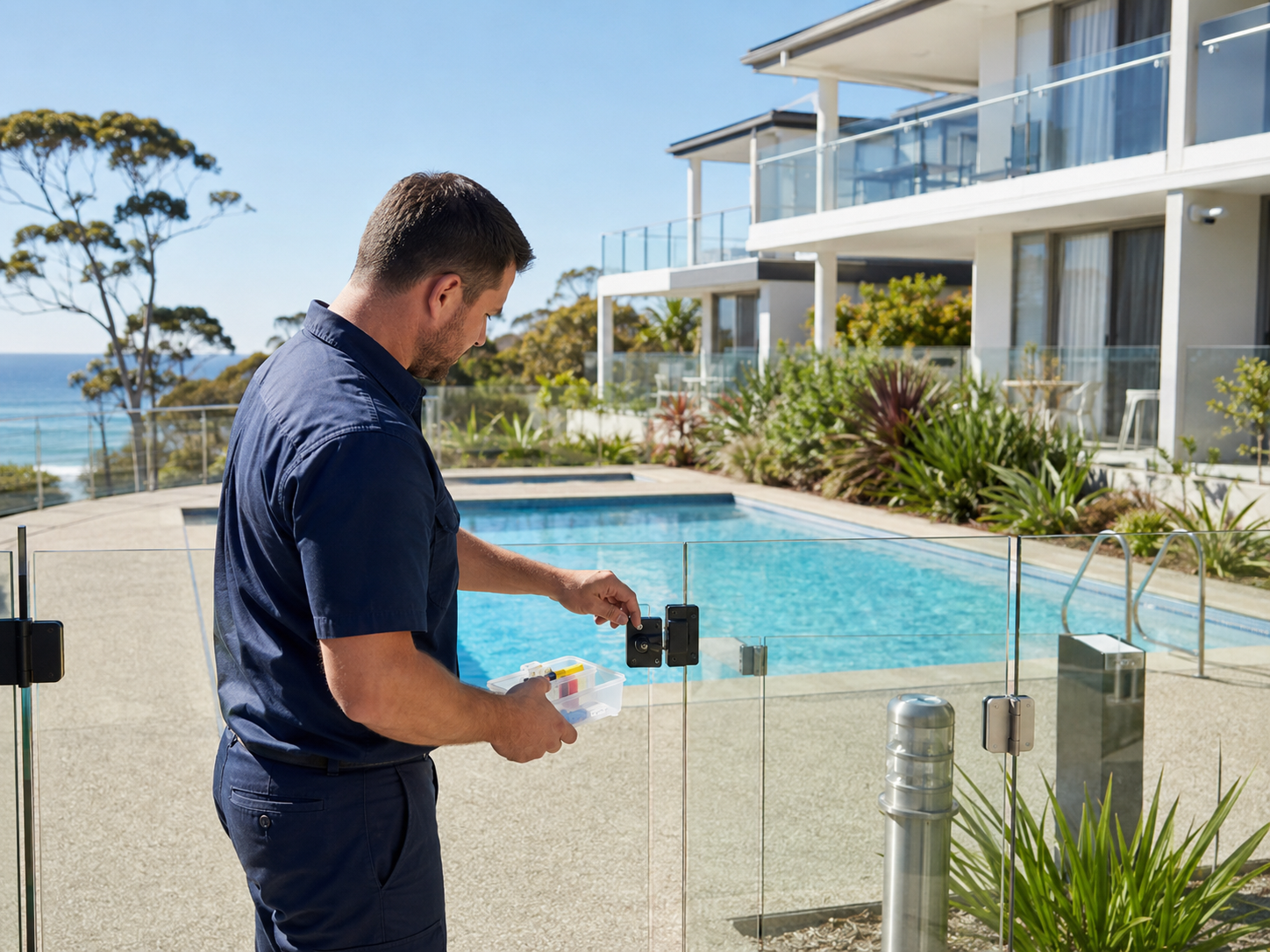
A compliant barrier is the primary physical control preventing unsupervised access by young children. NSW strata guidance gives baseline requirements that include fencing at least 1.2 metres high, gaps no greater than 10 centimetres, no climbable features, self-closing and self-latching gates, and a latch at least 1.5 metres above the ground. The exact standard that applies can depend on the pool's construction date, approved configuration and later alterations, so a current inspection checklist or qualified assessment should be used rather than measurements copied from a general article.
Bega Valley Shire Council notes that a pool generally must comply with the standard applying when it was built, while a barrier that is altered or rebuilt may need to meet the current standard. That distinction is technical. Replacing a gate, moving fencing, changing landscaping or adding structures around the pool should be reviewed before work starts so the scheme does not unintentionally create a new non-compliance issue.
The owners corporation should also display an approved cardiopulmonary resuscitation sign prominently in the pool area, commonly on the fence or gate. The sign must remain current, readable and visible; a faded sign behind furniture or vegetation is not a useful safety measure. Signage does not replace supervision, a working barrier or emergency training.
Simple barrier defects that can create serious risk
- A gate that no longer closes and latches from every open position.
- Furniture, pot plants, barbecues, bins or stored items within a climbable zone.
- Vegetation that obstructs the latch or gives a child a foothold.
- Corroded hinges, loose posts, failed fasteners or movement in glass panels.
- Excessive gaps under fencing caused by erosion, paving movement or landscaping.
- A propped-open gate during cleaning, deliveries or guest arrivals.
- A damaged, outdated or obscured CPR sign.
- A new door, window, deck, retaining wall or equipment enclosure that changes access to the pool area.
Committee rule
If the gate, fence or latch appears defective, restrict access and arrange competent inspection or repair promptly. Do not wait for the next scheduled service merely because the pool water still looks clean.
Water quality is a health responsibility, not just an appearance issue
Clear water is not proof that a pool is safe. Disinfectant level, pH, circulation, filtration, contamination response and testing frequency all matter. A professional service agreement should define what is tested, acceptable parameters, how results are recorded, who adjusts chemicals and when the pool must be closed.
NSW Health regulates public swimming pools and spa pools through the Public Health Act and Public Health Regulation 2022. Where a strata or holiday-accommodation facility falls within the public-pool framework, additional disinfection, monitoring and recordkeeping requirements may apply. Classification depends on how the facility is operated and accessed. Merimbula complexes mixing permanent residents, short-term guests, serviced accommodation or commercial management should confirm their position with Bega Valley Shire Council or NSW Health rather than assume that every residential pool is outside those requirements.
Even where the public-pool provisions do not apply, a sensible owners corporation uses documented water-quality controls. Peak holiday use, young children, warmer weather, heavy rain and accidental contamination can all change risk quickly. Spa pools require particular attention because warm water, small volume and high bather load can allow problems to develop rapidly.
A practical maintenance program for a Merimbula strata pool
The service frequency should be designed for the facility, equipment, usage and season. A useful program may include the following layers, without replacing the contractor's technical specification or regulatory requirements.
Frequent operational checks
- Check that the gate closes and latches correctly and has not been propped open.
- Look for damaged fencing, loose panels, climbable objects, sharp edges and trip hazards.
- Confirm the water is clear enough to see the bottom and that circulation appears normal.
- Inspect for contamination, debris, unusual odours, cloudy water or signs of an equipment fault.
- Ensure rescue equipment, lighting where provided, emergency contacts and CPR signage are accessible.
- Record the check and any action taken, particularly during high-use holiday periods.
- Routine professional servicing
- Test and adjust water chemistry at a frequency matched to use, temperature and the applicable legal requirements.
- Clean baskets, filters and surfaces; inspect pumps, chlorinators, dosing systems, heaters and spa equipment.
- Check for leaks, pressure changes, noisy bearings, electrical faults and deterioration in pipework or valves.
- Document readings, chemicals added, faults observed, parts replaced and follow-up recommendations.
- Escalate any result that requires closure or specialist attendance instead of leaving a note for the next visit.
- Planned building and asset inspections
- Arrange the statutory council inspection cycle and track the expiry of certificates and any notices.
- Inspect coping, tiles, grout, expansion joints, waterproofing, decks, drains, plant-room ventilation and structural movement.
- Review corrosion of fencing, handrails, fixings, plant and electrical enclosures in the coastal environment.
- Test residual-current devices, bonding, earthing, lighting and other electrical systems through appropriately licensed trades.
- Review accessibility, slip resistance, shade structures, furniture placement and safe chemical storage.
- Update the capital works plan for expected renewal of pumps, surfaces, fencing, heating, filtration and major components.
Coastal conditions: salt, corrosion, wind and rain
Merimbula's coastal environment can shorten the life of pool assets. Salt deposits retain moisture and accelerate corrosion, particularly where dissimilar metals, scratched coatings or poorly protected fasteners are present. Gate hardware can become stiff or unreliable. Electrical enclosures and plant-room components can deteriorate out of sight. A maintenance plan prepared for an inland building may therefore be inadequate near the coast.
Wind can carry sand, leaves and organic material into the pool, increasing filtration demand. Storms and intense rain may dilute chemicals, raise water levels, introduce contaminants and expose drainage weaknesses. After significant weather, the pool should be assessed before reopening rather than relying on the normal weekly timetable.
Committees should ask contractors to report trends, not only immediate faults. Repeated rust staining, water loss, cracked grout, movement around fence posts or abnormal chemical demand can be early signs of a larger problem. Early investigation is usually more manageable than emergency closure during the Christmas holiday period.
Holiday letting and seasonal occupancy
A pool serving short-term guests creates operational challenges that may be less pronounced in a wholly owner-occupied building. Guests may not know the gate rule, supervision expectations, opening hours or maximum occupancy. They may move furniture, bring glass into the area or allow children to enter without understanding the layout. Frequent turnover also makes it harder to rely on community knowledge.
The owners corporation should adopt clear, lawful and consistently enforced pool by-laws. Hosts and letting agents should give guests the rules before arrival and display concise instructions at appropriate access points. Access codes, keys and fobs should be controlled, and the scheme should have a process for reporting hazards outside normal office hours.
Rules should cover conduct rather than attempt to transfer the owners corporation's maintenance duty to residents. A by-law can prohibit glass, regulate hours, require supervision and address noise, but it cannot make a defective common-property gate the responsibility of whichever guest last used it.
Contractor selection and service agreements
The cheapest weekly price is not necessarily the best value. A robust pool contract should identify service frequency, testing, cleaning, consumables, emergency attendance, reporting, exclusions and approval limits. It should state who can close the pool and how the committee or strata manager will be contacted when a safety or water-quality issue is found.
The owners corporation should check licences and qualifications relevant to the actual work, insurance, regional availability and experience with shared residential or accommodation pools. Barrier certification, structural repair, electrical work, plumbing and chemical treatment are different disciplines. One contractor may coordinate several tasks, but the scheme should still know who is competent and authorised to perform each one.
Good reporting is essential for an absentee committee. A service note reading only "pool attended" provides little protection. The scheme should receive test results where applicable, work performed, defects, photographs when useful and a clear priority for recommended action.
Budgeting and the capital works fund
Routine cleaning, testing and small repairs are operating expenses. Resurfacing, major plant replacement, new fencing, structural repairs, drainage upgrades and substantial deck work should be anticipated through the capital works fund plan. Coastal exposure and seasonal demand should be reflected in expected useful lives rather than relying on generic estimates.
Current NSW Government guidance requires schemes to obtain at least two independent quotations for work valued at $30,000 or more. Even below that threshold, competitive quotations may help when the scope is significant or technically uncertain. Quotations should be based on the same written scope so the committee can compare method, exclusions, warranties and timing rather than price alone.
Deferring safety work because the budget is tight does not remove the risk. If necessary, the owners corporation may need to reprioritise expenditure, raise an additional levy, use available emergency authority or temporarily close the facility while a properly authorised funding decision is made.
When the pool should be closed
- A scheme should have a written closure and reopening process. Immediate restriction may be appropriate when:
- The barrier, gate or latch cannot reliably restrict access.
- Water clarity prevents the bottom from being seen or testing indicates unsafe conditions.
- There has been faecal, vomit or other significant contamination.
- Electrical equipment, lighting or exposed wiring presents a suspected hazard.
- Broken glass, sharp edges, loose coping, unstable fencing or a serious slip hazard is present.
- A pump, suction outlet, drain cover or circulation component may create an entrapment risk.
- Storm damage, flooding or structural movement requires assessment.
- Council, a certifier, health authority or competent contractor directs that the pool not be used.
- Closure should be communicated clearly, physically secured and documented. The pool should reopen only when the responsible professional confirms that the triggering issue has been resolved and any statutory direction has been satisfied.
Responding to an incident or near miss
- Call emergency services and provide first aid or CPR where required. Protect life before investigating responsibility.
- Secure the pool area and preserve evidence, including photographs, access records, CCTV and contractor logs.
- Notify the strata manager, committee and relevant insurer promptly, following the policy's requirements.
- Contact Council, NSW Health, SafeWork NSW or another authority where the circumstances require notification or direction.
- Arrange competent assessment of the barrier, equipment, water quality or structure before reopening.
- Record the sequence of events, decisions, communications and corrective actions without speculation or blame.
- Review the maintenance program, by-laws, contractor scope and emergency procedure so the underlying control failure is addressed.
- Records every owners corporation should keep
- NSW Swimming Pool Register confirmation and current scheme details.
- Council inspection bookings, reports, certificates, notices and evidence of rectification.
- Barrier, gate and CPR-sign checks, including dated photographs where useful.
- Pool-service logs, water-test records where applicable and contamination-response records.
- Contractor agreements, licences, insurance certificates, quotations, invoices and warranties.
- Plant manuals, commissioning information, electrical records and as-built plans where available.
- Committee decisions, meeting resolutions, expenditure approvals and resident notices.
- Incident, complaint and closure records, insurer notifications and professional reports.
- Capital works forecasts and asset-condition information for future renewal.
A committee checklist before summer
- Confirm the pool is registered and the required council inspection is current or booked.
- Review the fence, gate, latch, climbable zones and CPR signage with a competent person.
- Check the service agreement, summer attendance frequency and emergency callout arrangements.
- Inspect plant, drains, decks, lighting, furniture, rescue equipment and chemical storage.
- Review water-testing and contamination procedures, especially for spas and high guest turnover.
- Issue pool rules to residents, tenants, hosts and letting agents before peak occupancy.
- Confirm who may authorise urgent work or closure and how after-hours reports will be handled.
- Check insurance notification obligations and keep current emergency contacts accessible.
- Place foreseeable major renewal work into the capital works plan and budget.
Frequently asked questions
Who is responsible for a pool on common property?
The owners corporation is generally responsible for the common-property pool, barrier, shared plant and surrounding common areas. The strata manager coordinates work only within the agency agreement and delegated authority.
Does a Merimbula strata pool need to be registered?
Yes. NSW pools and spas covered by the legislation must be registered on the NSW Swimming Pool Register. Registration details and related certificates should be retained with the scheme records.
How often must a strata pool be inspected?
Current NSW Government guidance says strata schemes with more than two lots must have any pool or spa inspected by the local council every three years. Merimbula schemes should arrange this with Bega Valley Shire Council.
Are strata pools exempt from compliance certificates?
The sale-and-lease document requirement does not apply to a lot in a strata or community scheme with more than two lots. That limited exemption does not remove registration, inspection, barrier, signage or maintenance obligations.
Who pays for pool repairs?
Common-property pool repairs are normally paid by the owners corporation from its funds. The correct fund and approval pathway depend on whether the work is routine maintenance, a major renewal or urgent safety work.
Can the strata committee close the pool?
The committee or strata manager may be able to restrict access under delegated or emergency authority when there is a genuine safety risk. The scheme should have a written process and obtain professional or statutory direction where appropriate.
What pool rules should apply to holiday guests?
Useful rules address supervision, opening hours, noise, glass, smoking, furniture, access credentials and reporting hazards. Hosts and letting agents should provide the rules before arrival and remain responsible for guest conduct under applicable by-laws.
Does a weekly pool cleaner cover every responsibility?
No. Water servicing is only one part of the program. The scheme must also address barriers, gates, signage, statutory inspections, structure, electrical systems, drainage, corrosion, budgeting, contractor oversight and incident response.
Do NSW public-pool water rules apply to a strata pool?
It depends on how the facility is operated and accessed. Schemes involving serviced or holiday accommodation should confirm classification and any monitoring requirements with Bega Valley Shire Council or NSW Health.
How Essential Strata Management helps Merimbula schemes
Effective pool management is a governance system, not a single contractor visit. The owners corporation needs clear responsibility, current inspections, documented servicing, prompt defect escalation and realistic funding. That becomes particularly important in Merimbula complexes with seasonal occupancy, holiday letting, absentee owners and coastal exposure.
Essential Strata Management supports owners corporations across the NSW South Coast, including Merimbula, Tura Beach, Pambula, Pambula Beach and surrounding Bega Valley communities. We manage schemes ranging from 3 to 100 lots and can coordinate pool inspections, service contracts, quotations, committee decisions, resident communications, records and capital works planning.
Our role is to help the committee see what is due, what has been identified and what decision is needed. Technical matters are referred to appropriately qualified contractors, certifiers and advisers, while the owners corporation retains informed control of its common property and expenditure.
Suggested calls to action
Does your Merimbula strata complex have a pool or spa? Ask Essential Strata Management to review the scheme's inspection, maintenance and recordkeeping process.
Preparing for the summer holiday period? Talk to Essential Strata about contractor coordination, resident communication and practical common-property planning.
Considering a change of strata manager in Merimbula, Tura Beach or Pambula? Send us your current agreement, latest AGM minutes and building priorities for a confidential discussion.
For support coordinating pool contractors, maintenance records and approved shared-facility expenditure, learn more about Essential Strata Management in Merimbula.
Authoritative references
NSW Government - Safety rules for strata common property: https://www.nsw.gov.au/housing-and-construction/strata/serving-on-a-committee/safety
NSW Government - Owning a pool or spa: your obligations: https://www.nsw.gov.au/housing-and-construction/building-or-renovating-a-home/pools-and-pool-safety/owner-obligations
NSW Government - Strata repairs and maintenance: https://www.nsw.gov.au/housing-and-construction/strata/living/repairs-and-maintenance
Bega Valley Shire Council - Swimming pools and spas: https://www.begavalley.nsw.gov.au/Plan-and-build/Swimming-pools-and-spas
Bega Valley Shire Council - Pool registration: https://www.begavalley.nsw.gov.au/Plan-and-build/Swimming-pools-and-spas/Pool-registration
Bega Valley Shire Council - Swimming pool compliance: https://www.begavalley.nsw.gov.au/Plan-and-build/Certificates/Swimming-pool-compliance
NSW Health - Public swimming pools and spa pools: https://www.health.nsw.gov.au/environment/water/Pages/public-pools-and-spas.aspx
NSW Legislation - Swimming Pools Act 1992: https://legislation.nsw.gov.au/view/whole/html/inforce/current/act-1992-049
NSW Legislation - Swimming Pools Regulation 2018: https://legislation.nsw.gov.au/view/whole/html/inforce/current/sl-2018-0503
NSW Legislation - Strata Schemes Management Act 2015: https://legislation.nsw.gov.au/view/whole/html/inforce/current/act-2015-050
General information only. This article is current to 4 September 2026 and is not legal, building, pool-certification, public-health, engineering, insurance or financial advice. Pool standards, access arrangements, approvals and common-property boundaries differ between schemes. Owners corporations should check current official guidance and obtain advice from Bega Valley Shire Council, registered certifiers and appropriately qualified professionals for their property.